

SpaceX Rocket Part Set to Collide With the Moon This Wednesday
An upper-stage SpaceX Falcon 9 rocket is on a collision course with the Moon, offering scientists a rare research opportunity.

Stock photo for illustration only, not from the actual event
- An upper-stage SpaceX Falcon 9 rocket part is set to strike the Moon
- Traveling at approximately 2.43 kilometers per second or 5,400 mph
- Predicted to carve out a crater more than 17 meters wide near Einstein Crater
- Telescopes and lunar orbiters worldwide will track the impact event
The Moon has weathered countless impacts over millions of years, bearing the scars of asteroid strikes and ancient space missions. On Wednesday, Earth's natural satellite is scheduled to experience yet another high-speed collision, this time from a drifting SpaceX rocket component traveling at roughly 2.43 kilometers per second, or about 5,400 miles per hour.
Astronomers concluded that a piece of rocket hardware from a January 2025 launch was on an accidental collision course with the Moon by analyzing public data. SpaceX originally launched this specific Falcon 9 rocket on a joint US and Japanese mission to deliver lunar landers and scientific instruments to space.
While reusable Falcon 9 boosters return safely to Earth, upper-stage components often remain abandoned in orbit until they cross paths with celestial bodies. The object in question is the upper section of the rocket, roughly the size of a five-story building, weighing at least 4,000 kilograms (8,800 pounds) on Earth.
Astronomer Bill Gray, who initially calculated the trajectory, stated that the debris will strike near the Einstein Crater on the Earth-facing side of the Moon. He predicts the impact will leave behind a crater exceeding 17 meters (56 feet) in diameter, with the collision expected around 02:35 EDT (06:35 GMT) on Wednesday.
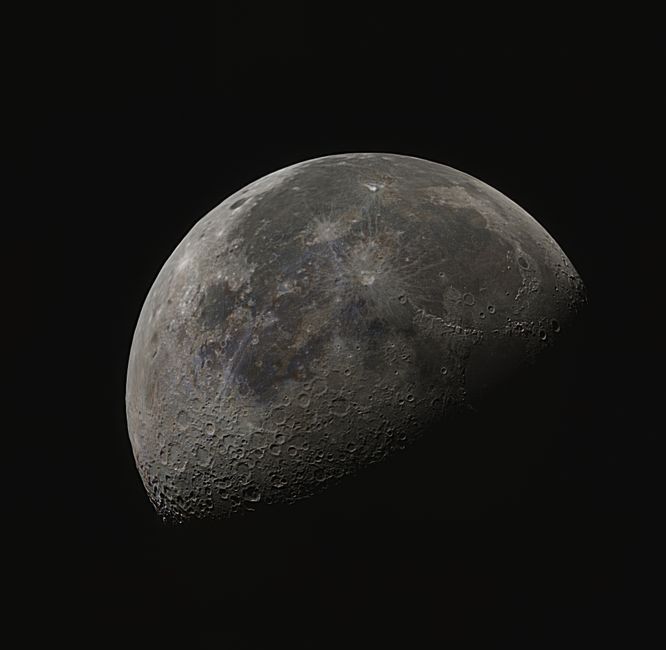
Stock photo for illustration only, not from the actual event
This upcoming lunar impact highlights the growing issue of orbital debris. According to the European Space Agency (ESA), approximately 54,000 objects larger than 10 centimeters currently litter space, contributing to a total of 17,000 tonnes of human-launched material since 1957. While a Chinese rocket stage struck the far side of the Moon in 2022, turning accidental impacts into scientific experiments allows researchers to refine impact models and study subsurface lunar composition without launching expensive dedicated probes.
Astronomer David Bothwell noted that unlike impacts on Earth, no atmosphere will slow the object down, nor prevent a million kilograms of pulverized debris from rocketing upward. Although the impact won't be visible to the naked eye from Earth, advanced telescope operators might catch a brief flash radiating from the lunar surface.
"This moment would present a unique opportunity to study what happens when an object hits the Moon."
David Bothwell
Research teams are gearing up to monitor the event closely. Major telescopes across the Americas, alongside NASA's Lunar Reconnaissance Orbiter and South Korea's Danuri probe, will track the flash and resulting plume, while citizen scientists capture footage to help researchers analyze subsurface lunar material.
Source: BBC Science & Environment
Found something wrong in this article? Report an issue with this article
Comments
Leave a Comment