

Relativity Networks raises $22M for faster data center fiber
Relativity Networks secured $22 million in SAFE funding from Rhapsody Venture Partners and others, alongside a $40 million pre-order, to deploy 30% faster hollow-core fiber.

Stock photo for illustration only, not from the actual event
- Relativity Networks raised $22 million in a SAFE note round backed by Rhapsody Venture Partners and Bell Ventures.
- The startup secured a $40 million follow-on order from an undisclosed leading hyperscaler.
- Hollow-core fiber technology transmits data through a vacuum chamber, achieving 30% faster speeds than conventional glass fiber.
- The innovation helps data center developers bypass geographical distance and power constraints.
Data center developers are projected to pour up to $4 trillion into infrastructure by the decade's end, yet they remain tightly bound by power grid limitations and political hurdles regarding where facilities can be constructed. While transmission speed in fiber optics has long been taken for granted, startup Relativity Networks is wagering that ultra-fast fiber can entirely reshape the geographical math of data center expansion.
On Tuesday, the company announced $22 million in SAFE note financing, drawing commitments from investors including Rhapsody Venture Partners, Bell Ventures Inc., and Faster Than Glass LLC. A SAFE note acts as a standard vehicle for pre-seed and seed investments before converting into equity upon a priced round. Furthermore, the firm locked in a $40 million follow-on order from a prominent hyperscaler who chose to remain anonymous.
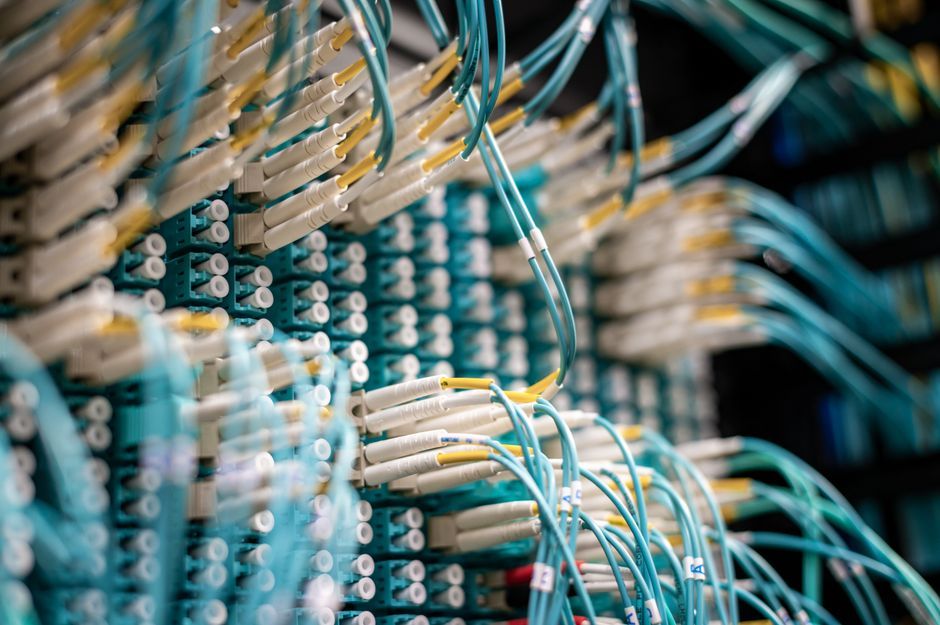
Stock photo for illustration only, not from the actual event
The core innovation lies in hollow-core fiber, a rarely utilized technology that transmits data 30% faster than standard fiber-optic lines. While traditional cables send light through solid glass, hollow-core architecture channels light through a central vacuum chamber, pushing closer to the theoretical speed limit of light.
The performance gain boils down to microseconds. CEO Jason Eisenholz estimates that a signal in conventional fiber takes roughly five microseconds to travel a single kilometer, whereas switching to hollow-core cuts that delay down to approximately 3.5 microseconds. By accelerating transmission times by 30%, developers gain the flexibility to stretch campus distances by 30% before latency becomes a critical bottleneck.
"The largest systems are distributing the compute across multiple campuses to reach the power that exists. They're moving to where the warm shell is, but they still need to operate as one synchronized machine."
Jason Eisenholz, CEO of Relativity Networks
As AI compute clusters scale massively, the physical distance between GPUs has expanded, with modern data center campuses sprawling across hundreds of acres and multiple buildings. Eisenholz highlights a major market opportunity in multi-campus deployments, where preexisting data facilities are stitched together to function as a unified system.
Editorial Analysis: Overcoming latency limitations via advanced physical media like hollow-core fiber represents a crucial paradigm shift for AI infrastructure. As data centers face severe geographical constraints due to local power availability, innovations that shrink virtual distance between separated campuses can ease spatial bottlenecks and redefine how hyper-scale infrastructure is planned globally.
Eisenholz views this technological shift as the natural progression of AI infrastructure development. He notes that the first era optimized core compute via GPUs, the second optimized internal data center networking, and the upcoming third era will focus squarely on optimizing geography.
Source: TechCrunch
Found something wrong in this article? Report an issue with this article
Comments
Leave a Comment