

Inherent says AI Faraday outperformed Anthropic and OpenAI
London-based AI lab Inherent, founded by Google DeepMind alumni, has secured a $50 million seed round and released Faraday, an AI agent that outperformed larger models at replicating scientific research.
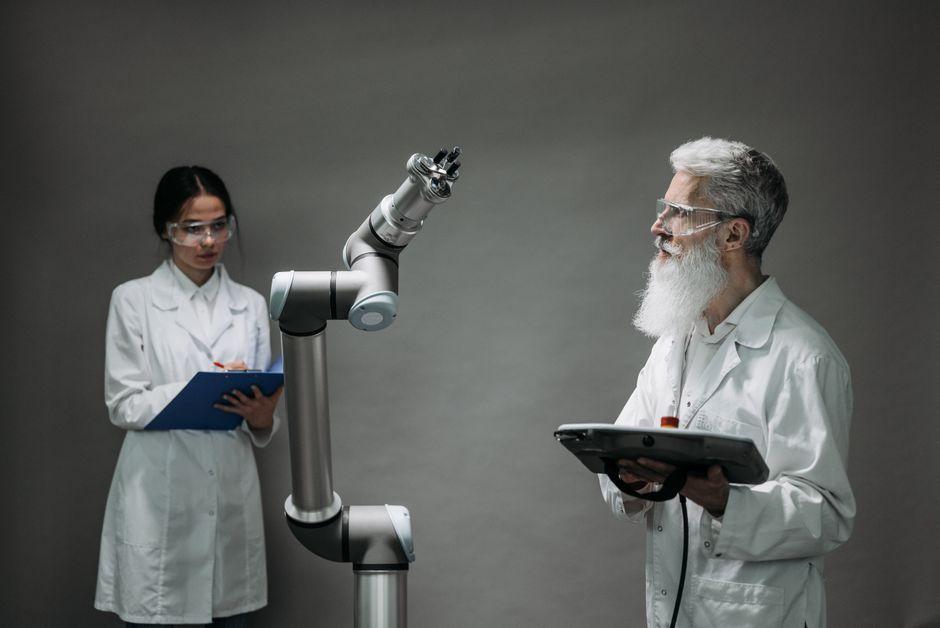
Stock photo for illustration only, not from the actual event
- Inherent is a London AI lab founded by former Google DeepMind researchers.
- The British startup recently emerged from stealth with a $50 million seed round.
- It developed an AI agent named Faraday designed to independently reproduce scientific papers.
- The company claims it outperformed larger models from Anthropic and OpenAI using a fraction of the size.
The artificial intelligence landscape is witnessing a notable challenger as Inherent, a London-based AI lab established by former Google DeepMind alumni, announces that its newly released AI agent has surpassed much larger models from industry heavyweights Anthropic and OpenAI. The breakthrough centers on a specific and rigorous capability: independently reproducing the findings of published scientific papers without prior knowledge of the final answer.
While several startups launched by former DeepMind researchers have garnered significant spotlight, Inherent has flown relatively under the radar until now. However, as better-funded competitors are still working to demonstrate tangible products, the British team is beginning to showcase its technology just weeks after emerging from stealth mode backed by a substantial $50 million seed round.
The ability of a compact AI agent to outperform massive foundation models in scientific replication highlights a broader shift in the AI industry. Rather than relying solely on brute-force scaling of parameters, specialized training paradigms like reinforcement learning are proving crucial for complex analytical tasks where factual accuracy and procedural logic are paramount.
To overcome the inherent difficulty of teaching intangible qualities like scientific taste to a machine, the startup relies heavily on reinforcement learning. Instead of explicitly spelling out rigid rules for the system to follow, this training methodology rewards the AI for achieving desirable outcomes, ensuring better generalization across various scientific domains over the long term.

Stock photo for illustration only, not from the actual event
Edward Hughes, co-founder of Inherent, noted that the company is deliberately steering away from building assistants that simply tell users what they want to hear. Instead, the team envisions an AI teammate modeled after an ideal human colleague—one who takes the initiative to investigate curiosities independently and brings back experimental results for collaborative discussion.
"I got curious about this, and I went off and I did these experiments. What do you think of these results?"
Edward Hughes
This milestone marks a significant step forward for Inherent as it transitions from stealth to public development. By focusing on agentic capabilities that mirror scientific inquiry, the London lab is positioning itself as a serious contender in the next generation of practical artificial intelligence research tools.
Source: TechCrunch
Found something wrong in this article? Report an issue with this article
Comments
Leave a Comment