

Hugging Face Microduck: $399 Open-Source Biped Robot
Hugging Face and Pollen Robotics launch Microduck, a $399 open-source 25cm biped robot trained with Reinforcement Learning.
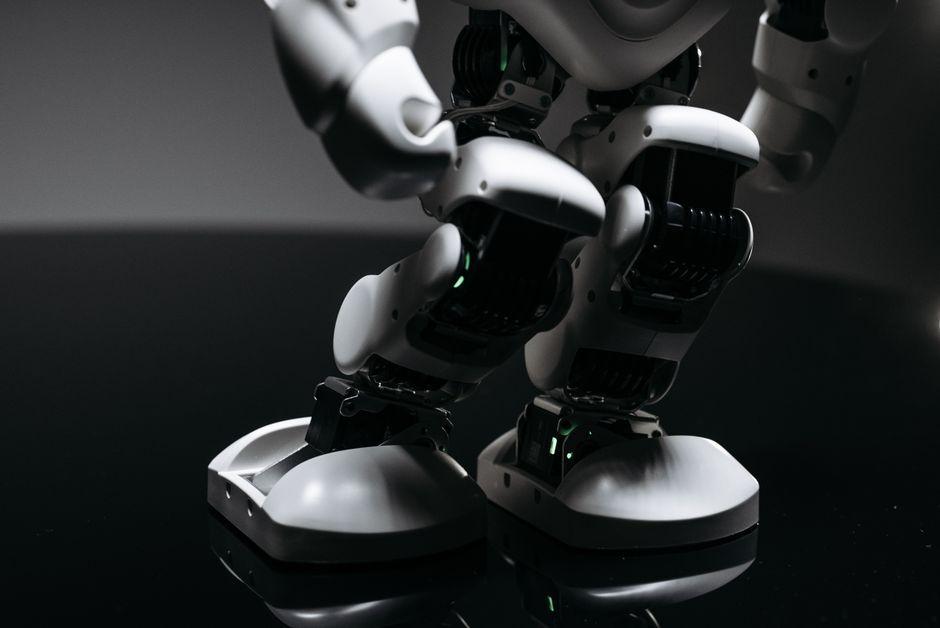
Stock photo for illustration only, not from the actual event
- Hugging Face and Pollen Robotics unveiled the Microduck biped robot priced at $399.
- It stands 25 cm tall, 14 cm wide, and weighs under 800 grams with 15 motors.
- Policies are trained using Reinforcement Learning on mjlab and MuJoCo Warp.
- Powered by a Rockchip RK3566 processor with LiDAR and a swappable battery.
Hugging Face has partnered with Pollen Robotics to introduce Microduck, a new open-source bipedal robot priced at $399. The compact robot is designed to let users train behaviours directly through Reinforcement Learning while packing impressive hardware specifications for its price point.
Physically, Microduck measures 25 centimeters in height, 14 centimeters in width, and weighs under 800 grams. It integrates 15 motors distributed across its legs, neck, and head, alongside an articulated beak capable of picking objects off the floor. Computing is handled by a Rockchip RK3566 chip featuring an AI accelerator, 1 GB of RAM, and 32 GB of storage.
The sensor stack includes a front camera behind a dedicated indicator, dual IMUs located in the body and head, an 8x8 time-of-flight LiDAR matrix, microphones, a speaker, dual NFC antennas, and Wi-Fi and Bluetooth connectivity. It runs on a removable 2600 mAh NP-F550 battery providing about one hour of operation.
Out of the box, the robot ships with seven pre-trained movements controlled via a bundled game controller: walking, sitting and standing, kicking, grabbing, roller-skating, and self-recovery. The robot does not speak verbally, instead generating a permanent audio identity upon its first wake-up.
The introduction of Microduck marks a significant step in democratizing educational robotics hardware. By combining an open-source framework with MuJoCo Warp simulation tools, developers and researchers can bridge the sim-to-real gap efficiently without needing expensive laboratory setups.
Policies are trained within microduck_rl built on mjlab using PPO algorithms. Pollen reports that obtaining a usable gait takes roughly one to two hours on a CUDA GPU across 4096 parallel environments, with an option to run commands on Hugging Face Jobs when a local GPU is unavailable.

Stock photo for illustration only, not from the actual event
Sim-to-real transfer relies on a detailed actuator model utilizing the BAM M6 model of the Dynamixel XL330, accounting for voltage control laws and friction variations. A Rust runtime drives the 50 Hz control loop on the robot, ensuring smooth policy execution and hot-swapping capabilities.
Source: MarkTechPost
Found something wrong in this article? Report an issue with this article
Comments
Leave a Comment