

Spok Brillor bends tennis geometry into optical loop at Casa Axis
Spanish urban artist Spok Brillor transforms a tennis court into an optical illusion piece titled Hard Court 2 at Casa Axis in Valencia, Spain.
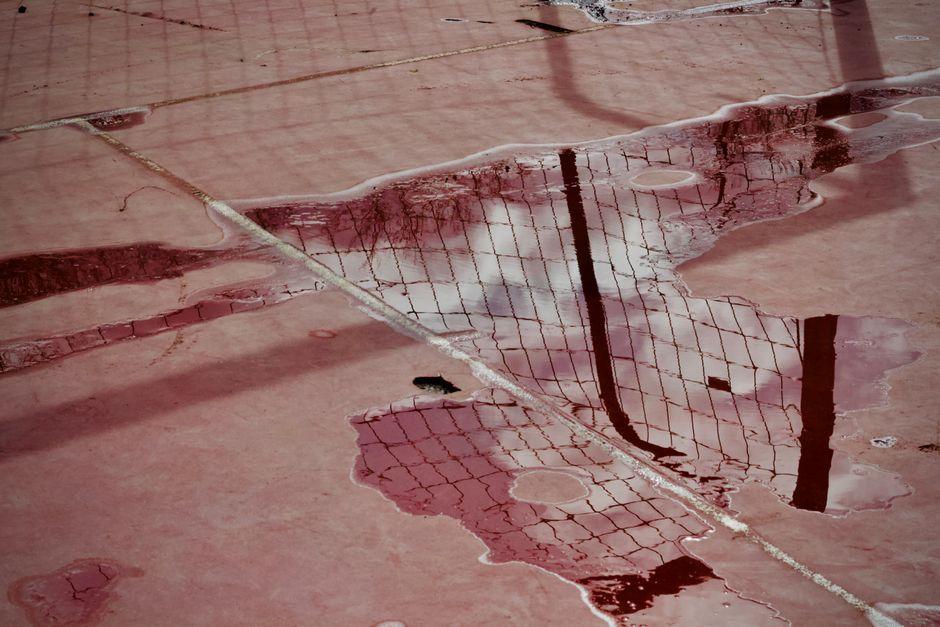
Stock photo for illustration only, not from the actual event
- Spok Brillor creates Hard Court 2, an optical illusion tennis court in Valencia
- The project stems from C.A.I.O., an artist tennis tournament with a painting prize
- Repeated court markings draw inward, creating the illusion of a sinking surface
- The playable court alternates between athletic competition and public art installation
Across the tennis court at Felipe Pantone’s Casa Axis in Valencia, Spain, familiar white lines behave in unexpected ways. They follow standard geometry briefly before multiplying toward the center, bending through metallic gradients until the entire surface appears to drop away beneath the players. Spanish urban artist Spok Brillor created Hard Court 2 during a 12-day residency at the creative space, painting an optical version of the court directly onto the playing surface.
This intervention extends a project that began in 2025, when Lucas Benarroch, known as MRKA, painted the first Hard Court across the same playing surface using irregular, hand-drawn lines. Spok takes the opposite visual approach while keeping the court recognizable, using regulation markings as raw material for an image that appears to recede beneath the ground with chrome-like passages reflecting the surrounding environment.

Stock photo for illustration only, not from the actual event
Behind this shifting surface is C.A.I.O., the Casa Axis International Open, an artist tennis tournament launched in June 2026. The tournament carries an unusual prize: the winner assumes responsibility for transforming the court ahead of the following edition. MRKA won the inaugural tournament after painting the 2025 court, subsequently handing this year’s intervention to Spok, who competed alongside him.
Integrating optical art with athletic infrastructure highlights the modern architectural concept of adaptive reuse, proving that contemporary art transcends gallery walls to merge seamlessly with functional spaces while preserving their primary utility.
This rule grants the tennis match an afterlife beyond the final point, leaving behind a playable artwork that subsequent artists will paint over year after year. While the first Hard Court emerged from friction between standardized markings and loose gestures, Hard Court 2 relies on repetition, pulling the markings inward until actual boundaries become difficult to discern.
Emerging from Madrid’s graffiti scene in the 1990s, Spok has since worked across painting, muralism, and installation, utilizing architectural space and science fiction-informed imagery. At Casa Axis, these interests meet a rigorous canvas, working directly with the complete spatial drawing of a tennis court by scaling down lines and shifting surfaces into polished, liquid-like passages.
Source: designboom
Found something wrong in this article? Report an issue with this article
Comments
Leave a Comment