

Dennis Vanderbroeck Creates Settings for Shared Moments
Dutch spatial designer Dennis Vanderbroeck shares insights behind his runway set designs for Diesel and Miu Miu.

Stock photo for illustration only, not from the actual event
- Dutch spatial designer Dennis Vanderbroeck blends fashion, theater, and music.
- His work with Diesel utilized scaffolding structures to emphasize collective energy.
- The collaboration with Miu Miu in Paris recreated the intimacy of 1990s runway shows.
A fashion show or a live performance may last only a few minutes, but what happens in the room is harder to capture. For Dennis Vanderbroeck, this temporary collectiveness is at the heart of his work, which moves between fashion, theater, music, and performance. The Dutch spatial designer approaches his work as a way to bring people together and shape how they encounter one another.
With a background in theater, Vanderbroeck focuses on the experience a setting creates. His designs set the scene for encounters between performers and audiences, leaving room for the unexpected. ‘I always say that our designs are just a tool to facilitate the experience, it’s more about the experience of the moment than the space itself,’ he tells designboom. At the latest Milan and Paris fashion weeks, the designer developed two distinct approaches to staging fashion, from a scaffolded runway that emphasized collective energy for Diesel to a modular arrangement that suggested movement and change for Miu Miu.
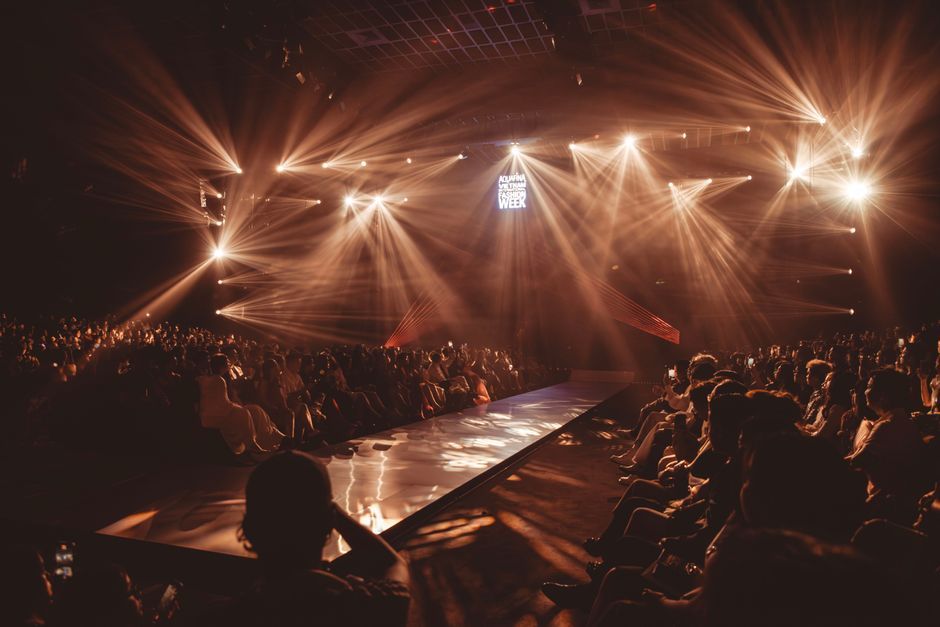
Stock photo for illustration only, not from the actual event
Vanderbroeck’s recent collaborations with Diesel and Miu Miu reveal two different ways of exploring this relationship. His work with Glenn Martens at Diesel developed over several shows, with a shared interest in making fashion more inclusive and approachable. Their final collaboration for the brand brought these ideas together through a rigid scaffolding structure and a performative setting shaped by community, presence, and disruption. The contrast between the group and the individual became central to the experience.
"I always say that our designs are just a tool to facilitate the experience, it’s more about the experience of the moment than the space itself."
Dennis Vanderbroeck
For the Miu Miu Spring/Summer 2027 show at the Palais d’Iéna in Paris, Vanderbroeck approached the runway through a different kind of proximity. Working with the brand for the first time, the designer and his team developed a space with tightly arranged bleachers and a narrow catwalk, recalling the intimacy of 1990s runway shows. The audience sat close together, while the models passed directly in front of them.
The concept of designing temporary spaces that anticipate multiple uses not only enhances the aesthetics of fashion shows but also reflects modern architectural philosophies. It views space not as a static structure, but as a social framework that readily adapts to the evolving contexts of its users and the passage of time.
Although the two projects grew out of different conversations, both explored the relationship between the individual and the group, with Vanderbroeck highlighting his ongoing fascination with this friction. The idea of a space anticipating its next use also shaped his first collaboration with Miu Miu, developed in relation to Geste de Consolation, an upcoming exhibition by French filmmaker Alice Diop presented as part of the Art Basel Paris Public Program from October 21st to 25th, 2026.
Tracks laid across the floor supported modular bleachers, giving the runway a sense of movement even though the structure itself remained still. The arrangement anticipated the exhibition that would follow, with elements of the fashion show intended to be reconfigured and given a different meaning in a new context. Vanderbroeck describes this approach as a dynamic stage, drawing on his background in theater to treat a set not as a finished backdrop but as something accommodating different situations over time.
Stock photo for illustration only, not from the actual event
Theater remains an important reference point in Vanderbroeck’s practice, even when designing for other forms of performance. For Issey Miyake’s OPEN STUDIO at Tate Modern, he drew on the circular form of the museum’s concrete tanks to explore intimacy and the idea of an embrace, using the architecture's geometry to shape different degrees of proximity between performers and audience members.
Source: designboom
Found something wrong in this article? Report an issue with this article
Comments
Leave a Comment