

Giant fin whale swallows thousands of gallons off Wales
Videographer Rhys Morgan captured footage of the world's second-largest whale lunge feeding off the Pembrokeshire coast in Wales, swallowing up to 18,000 gallons of water and krill.

Stock photo for illustration only, not from the actual event
- Rhys Morgan filmed a fin whale swallowing 18,000 gallons of water in Wales
- Fin whales are the second-largest animals on Earth, reaching 24m
- Dr Marianna Chimienti noted that coastal sightings are exceptionally rare
Amateur videographer Rhys Morgan has captured a rare moment showing the planet's second-largest living creature opening its massive jaws to swallow thousands of gallons of water during feeding. The encounter took place off the Pembrokeshire coast in Wales while he was out fishing and using a drone to film marine life swimming alongside dolphins.
During the lunge-feeding process, the whale's expandable pleats allowed it to take in up to 18,000 gallons of water and krill in a single motion. Morgan noted that capturing the footage alongside swimming dolphins was entirely a matter of complete luck.
Second only to the blue whale, the fin whale stands as one of the largest animals ever to have lived, growing up to 24 meters in length and weighing up to 70 tonnes. Despite their immense proportions, these fast-swimming mammals remain elusive, spending most of their lives in the open ocean and surfacing only briefly before vanishing beneath the waves.
"We do what we can to keep our distance in the boat but unfortunately nature can have a mind of its own sometimes. The wildlife will approach you sometimes."
Rhys Morgan
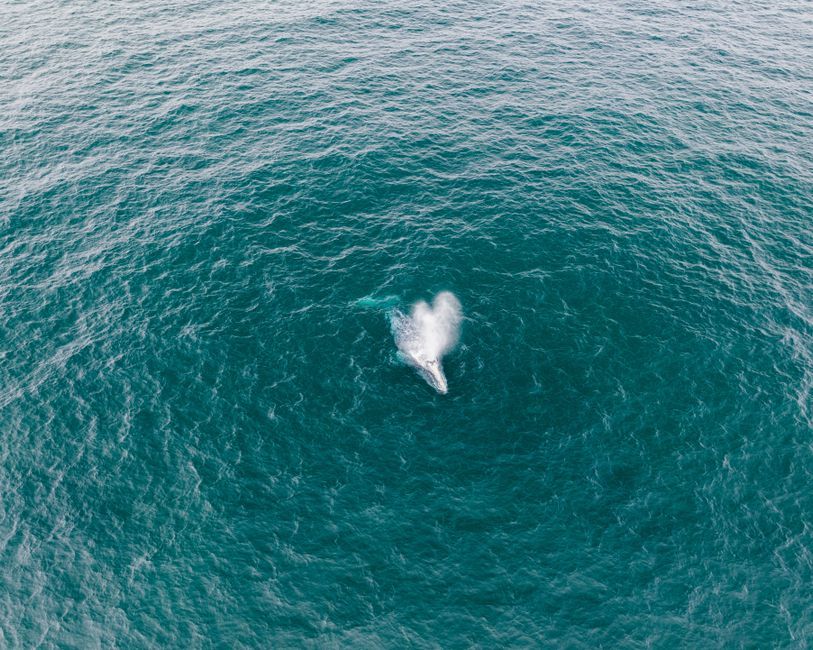
Stock photo for illustration only, not from the actual event
The lunge-feeding behavior exhibited by the fin whale highlights a high-energy survival strategy required to consume tiny prey like krill relative to their massive body size. These whales rely on expandable throat pleats that distend significantly to capture huge volumes of water before filtering it out through baleen plates, leaving the prey behind for consumption.
Dr Marianna Chimienti, a lecturer in marine top predator ecology at Bangor University, stated that Morgan experienced a rare and fortunate encounter. While surface-foraging is part of the species' normal feeding strategy, spotting them in coastal waters is quite spectacular, especially since they should theoretically have migrated elsewhere.
Scientific understanding of fin whale migration remains limited, though their movement patterns are believed to differ significantly from other baleen whales like blue and humpback whales. Researchers have observed that fin whales are generally more abundant in higher latitudes during warmer months and lower latitudes during colder months, sustaining themselves on a diet of krill, small schooling fish, and squid that requires consuming up to 2,000 kilograms of food daily.
Source: BBC Science & Environment
Found something wrong in this article? Report an issue with this article
Comments
Leave a Comment