

NUS 2026: Electronic fibers weave touchscreen into machine-washable sleeve
NUS researchers led by Assistant Professor Tural Khudiyev have developed electronic fibers integrating LEDs and touch sensors into a 168x105mm sleeve display that remains breathable and withstands 50 machine wash cycles.

Stock photo for illustration only, not from the actual event
- NUS researchers embed touchscreens and LEDs directly into fabric textile fibers.
- A 168x105mm prototype sleeve displays images, video, and connects via Bluetooth.
- Retains performance after 50 machine wash cycles and 1,000 bending rotations.
- Future applications include personalized healthcare monitoring and wearable AI.
Conventional wearable technology typically attaches rigid screens or electronic devices to the human body, but researchers at the National University of Singapore (NUS) have taken a radically different path by embedding display and touch functionality directly into individual thread fibers. Led by Assistant Professor Tural Khudiyev, the team integrated 54 specialized fibers into a garment sleeve to create a flexible display capable of rendering images and videos, responding to touch inputs, and connecting wirelessly to external digital devices while retaining the natural breathability and flexibility of standard everyday clothing.
Overcoming the strict geometrical limitations of narrow, cylindrical threads required a sophisticated interconnection architecture that connects thousands of microelectronic components along a single fiber. The fabrication process begins with tiny insulated wires exposed by a laser at precise intervals, followed by controlled wetting to guide molten solder to specific locations without bridging unintended paths. Using this method, the research team successfully integrated over 5,000 microchips via more than 20,000 electrical connection points before incorporating them into a multilayer fiber through an advanced thermal drawing technique.
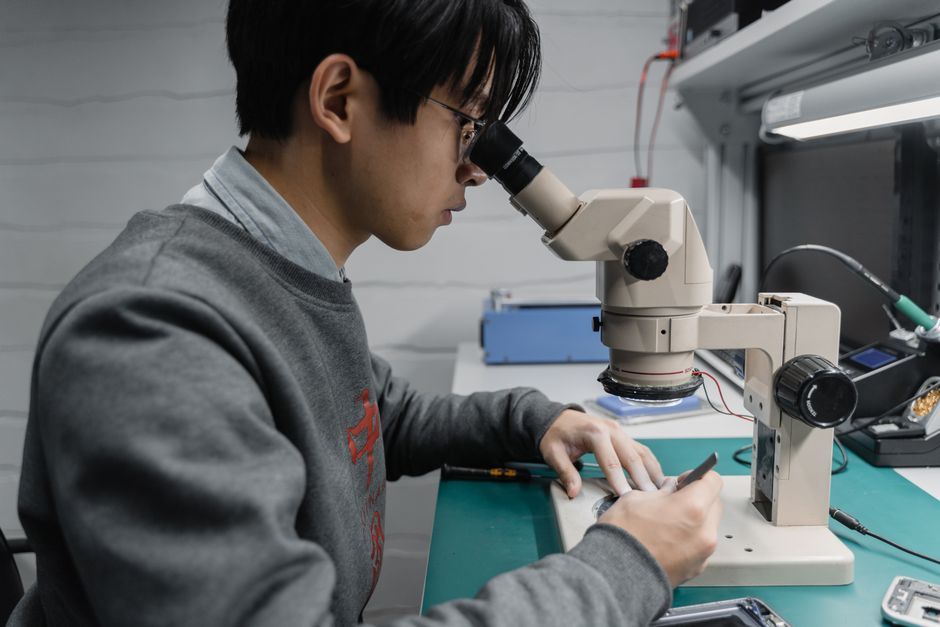
Stock photo for illustration only, not from the actual event
For their functional demonstration prototype, the team threaded 54 pixel-embedded strands into the forearm section of a sleeve, yielding a 96-by-54 pixel display measuring 168 by 105 millimeters with a 30 frames-per-second refresh rate and 8-bit color depth. Beyond displaying static photos and video playback, the sleeve can run basic utilities like a calculator and compass, receive images via Bluetooth, execute voice commands, and automatically adjust orientation or brightness. Additional embedded fibers incorporate a microphone, speaker, and various sensors to monitor motion, ambient light, magnetic orientation, and temperature directly from the wearer's body.
Durability testing confirmed that the prototype retained nearly unchanged optical light output and touch sensitivity performance even after enduring 50 complete machine-washing cycles with standard laundry detergent alongside 1,000 repeated bending cycles around a five-millimeter radius. Furthermore, the embedded textile display maintains breathability metrics comparable to traditional cotton, polyester, and denim fabrics while strictly adhering to skin-contact safety regulations.
This breakthrough in smart textile engineering highlights a fundamental paradigm shift in human-computer interaction. By moving away from bulky external gadgets and rigid panels toward material-integrated electronics, everyday garments can evolve into seamless functional displays. While current prototypes still feature modest resolutions compared to modern smartphones, integrating on-device artificial intelligence and expanded sensor arrays points toward a future where health diagnostics and digital information are woven directly into our daily attire.
Healthcare monitoring stands out as a primary prospective application for this innovation. Continuous physiological data gathering paired with direct garment display interfaces would allow wearers to track vital health metrics instantly without consulting separate companion devices. Although AI integration remains a goal for future development rather than a demonstrated feature of the current hardware, upcoming research milestones will focus on boosting display resolution, expanding sensor capabilities, and exploring on-device intelligence to redefine how we interact with ambient technology.
Source: designboom
Found something wrong in this article? Report an issue with this article
Comments
Leave a Comment