

Desert Playgola 2026: Sensory Playground in El Paso
Desert Playgola by Miguel Mendoza at Chalk the Block on October 3-4, 2026, in El Paso, explores an urban children's perspective from 95 cm above ground.

Stock photo for illustration only, not from the actual event
- Desert Playgola designed by Miguel Mendoza for the Chalk the Block festival on October 3-4, 2026
- Built from a 95-centimeter child's perspective to let kids explore at their own pace
- Features recycled timber, iridescent curtains, and desert-inspired MDF cactus sculptures
- Located along W Main Drive next to La Nube interactive museum in El Paso, Texas
What does a city look like from just 95 centimeters above the ground? In downtown El Paso, Texas, Nómada Estudio Urbano explores this question through Desert Playgola, a temporary pavilion that transforms a traditional pergola into an interactive playground. Designed by Miguel Mendoza for the Chalk the Block public art festival held on October 3-4, 2026, the installation combines desert-inspired sculptures, iridescent curtains, and recycled materials to create an environment where children can move, touch, and discover at their own pace. Commissioned by the City of El Paso through its Museums & Cultural Affairs Department (MCAD), the project occupies a pedestrian area along W Main Drive, turning an ordinary stretch of the city into a place for unexpected encounters.
The pavilion is built around a timber framework supported by concrete block bases, featuring hanging iridescent curtains and colorful figures made from medium-density fiberboard (MDF). Recycled wooden pallets form a series of raised platforms covered in artificial turf, introducing changes in height and texture across the installation. Freestanding sculptures resembling prickly pear cacti are assembled from interlocking MDF pieces, bringing elements of the surrounding landscape within children's reach. Together, these components transform the familiar pergola into a small terrain of passages, surfaces, and objects that invite visitors to explore rather than simply walk through.
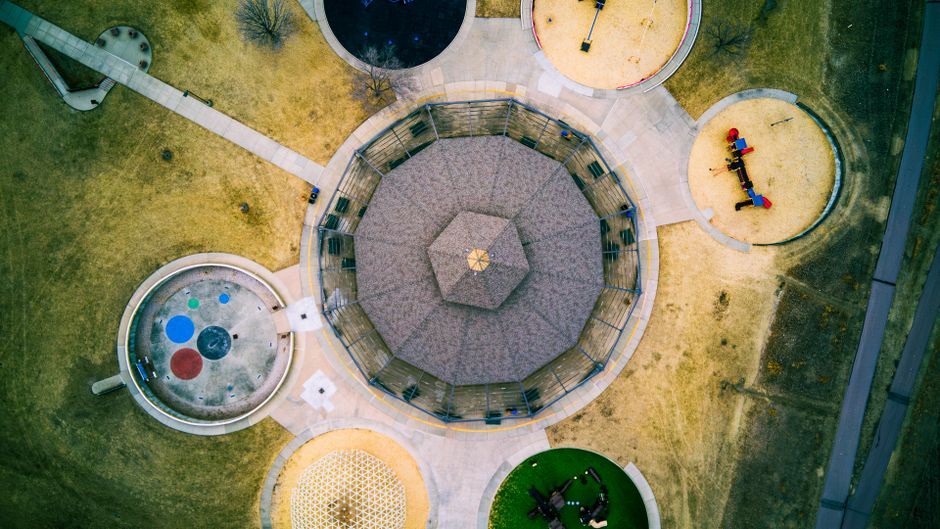
Stock photo for illustration only, not from the actual event
Movement, light, and touch play an equally important role in the experience. Wind animates the iridescent curtains, sunlight projects shifting shadows across the ground, and artificial lighting transforms the pavilion's appearance after dark. Children can pass between hanging elements, climb onto low platforms, examine different textures, or simply find a place to pause. There is no prescribed sequence to follow, and the installation accommodates different ways of engaging with its materials and spaces. The result is a playground that offers possibilities rather than instructions, allowing its youngest visitors to decide what happens next.
Designing urban spaces from a 95-centimeter perspective—roughly the height of a three-year-old child—highlights the growing movement of Child-Friendly Cities urbanism. This approach prioritizes human-scale infrastructure and public spaces tailored to a child's sensory perception and physical reach, moving away from adult-centric urban design. Utilizing recycled and local materials also reinforces sustainable design principles within temporary public installations.
Positioned beside La Nube, El Paso's interactive museum, Desert Playgola extends the idea of playful learning into the surrounding public realm. Its temporary presence during Chalk the Block introduces a different rhythm to the pedestrian route, encouraging visitors of different ages to stop, explore, and share the same space. For Nómada Estudio Urbano, the project reflects a broader interest in making cities more responsive to children's experiences without separating them from everyday urban life. The studio summarizes its approach with a simple premise: a city that plays is a city that cares. In this case, it begins by bringing the city a little closer to the ground.
Source: designboom
Found something wrong in this article? Report an issue with this article
Comments
Leave a Comment