

Alvaro Urbano brings Casa Cueva botanical memories to Museo Jumex
The Helen exhibition by Spanish artist Alvaro Urbano runs at Museo Jumex in Mexico City from October 16, 2026, to February 7, 2027, inspired by Helen Fowler O’Gorman's botanical legacy.

Stock photo for illustration only, not from the actual event
- Alvaro Urbano presents the Helen exhibition at Museo Jumex in Mexico City
- The exhibition runs from October 16, 2026, to February 7, 2027
- The project draws inspiration from Casa Cueva and Helen Fowler O’Gorman
- Botanical illustrations are translated into three-dimensional metal and paint sculptures
Architectural history often begins with the person tending the garden. In the Helen exhibition at Museo Jumex in Mexico City, Spanish artist Álvaro Urbano approaches Casa Cueva through the botanical imagination of Helen Fowler O’Gorman, the artist who shared the home with her husband, architect and artist Juan O’Gorman. Built in the mid-20th century within Pedregal de San Ángel, the residence brought architecture into direct contact with the surrounding terrain and vegetation. Curated by Rosela del Bosque and Carolina Estrada García, the exhibition is scheduled to run from October 16, 2026, to February 7, 2027.
Urbano discovered Helen through conversations with Mexican friends, whose stories about Casa Cueva inspired him to investigate her artistic practice. In an exclusive interview, he notes that in spaces constructed by their own inhabitants, architectural choices are deeply tied to everyday living. For the artist, the house itself functioned as a sculpture, where its connection to the landscape was inseparable from the daily routines of the people who lived there. The garden cultivated by Helen belonged to this same spatial conception, emphasizing observation and ongoing care.
Exploring architecture through the perspective of its inhabitants and surrounding flora reveals dimensions often overlooked in mainstream historical records. Casa Cueva serves not merely as a physical structure, but as a living environment reflecting the mid-20th-century relationship between human habitation and Mexican nature.
Inside her studio at Casa Cueva, Helen spent fifteen years working on her book published in 1961 as Mexican Flowering Trees and Plants. Its scope extended across the wider Mexican landscape, which she explored alongside Juan. While he searched for diverse minerals for his petro-murals, she gathered flowers and plants. Urbano reflects that this shared search for color provided an intimate and beautiful point of departure for understanding their creative lives.
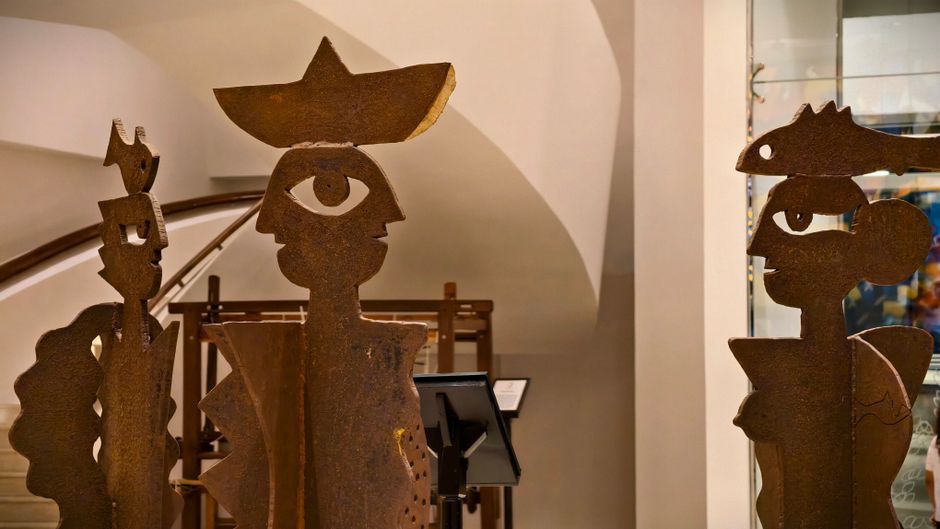
Stock photo for illustration only, not from the actual event
Because Helen’s original watercolors were lost, Urbano turned to the printed reproductions from her book, translating their botanical imagery into three-dimensional forms constructed from metal and paint. He explains that these sculptures were conceived as small monuments dedicated to her attentive observation of Mexico's flora. Within the installation, these pieces coexist with references to the geological landscape of Pedregal, Juan's petro-murals, and subsequent alterations made by later resident and Mexican artist Helen Escobedo.
"We do not know whether the petro-murals are being covered or uncovered. Rather than fixing an original state of the house, I wanted its different times to coexist."
Alvaro Urbano
This enduring interest in unfinished narratives spans across Urbano’s artistic practice. By employing fictional elements, he alters coordinates and brings together moments that never strictly coincided, allowing architecture to emerge as a character capable of voicing its own transformations, triumphs, and failures over time.
Source: designboom
Found something wrong in this article? Report an issue with this article
Comments
Leave a Comment