

Parallel World 2026: Living Garden Mimics Moth Vision
At Ars Electronica Festival 2026, artist Adrien Lucca presents Parallel World, a living indoor garden that shifts colors to simulate how nocturnal moths perceive flowers.

Stock photo for illustration only, not from the actual event
- Parallel World was showcased at the 2026 Ars Electronica Festival in Linz, Austria.
- It uses computer-controlled LED illumination to mimic elephant hawkmoth vision.
- Studies show artificial lighting reduces nocturnal flower visits by 62 percent.
At the 2026 Ars Electronica Festival in Linz, Brussels-based artist Adrien Lucca and a team of scientists presented Parallel World, an indoor living garden illuminated by a computer-controlled LED system. The installation transforms a static arrangement of plants into a shifting meadow, altering its color composition at regular intervals while every flower stays securely in place.
Beneath the shifting bluish light, green foliage turns brown or nearly black, while the pink blossoms stand out with unusual brightness. This simple visual experiment demonstrates that the colors we perceive in a garden represent only one interpretation of reality, whereas other creatures experience the exact same environment in drastically different ways.
Studio Adrien Lucca developed the installation based on the visual system of the elephant hawkmoth (Deilephila elpenor), a nocturnal pollinator capable of distinguishing colors under extremely dim illumination. While human color perception fades after sunset, these insects utilize ultraviolet wavelengths alongside the blue-to-green spectrum to navigate at night, supported by research published in Nature in 2002 confirming their color vision in starlight-level conditions.
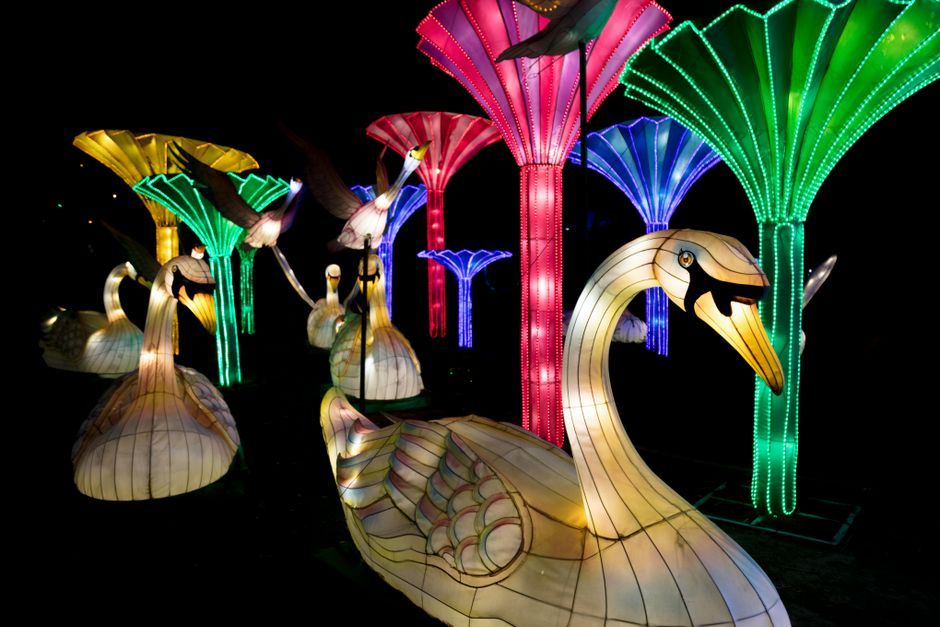
Stock photo for illustration only, not from the actual event
Lucca collaborated with color scientist Ali Aiman Raza, researcher Colas Schretter, and biologist Marko Ilić to translate the hawkmoth's visual world into programmable lighting that human visitors can experience. Although human eyes cannot directly detect ultraviolet light, the changing garden offers a tangible approach to an otherwise inaccessible sensory experience.
Parallel World bridges contemporary art and ecological science, highlighting how urban artificial lighting impacts nocturnal pollinators beyond human awareness. Understanding cross-species visual differences provides crucial context for how modern lighting design alters natural behaviors and ecosystems after dark.
The installation builds upon Lucca's previous investigations into plant pigmentation and artificial light, including his 2022 Mondes parallèles project and 2025 exhibitions in Brussels. Furthermore, research cited from Nature in 2021 indicates that specific artificial light spectra, such as narrow-band orange lighting, impair a moth's ability to distinguish floral colors from foliage, directly impacting plant reproduction and pollination rates.
Source: designboom
Found something wrong in this article? Report an issue with this article
Comments
Leave a Comment