

JAWF 2026: Hydromechanical Stainless Steel Design by Sarah Naghawi
At Amman Design Week 2026, Sarah Naghawi presents JAWF, an experimental collection exploring hydromechanical forming on reflective stainless steel.

Stock photo for illustration only, not from the actual event
- JAWF premiered at Amman Design Week 2026 by designer Sarah Naghawi
- Applies industrial hydromechanical forming to shape stainless steel sheets
- Reflective metallic surfaces permanently record internal liquid pressure traces
Contemporary design continues to push material boundaries by merging industrial fabrication with sculptural art. At Amman Design Week 2026, an experimental design collection titled JAWF by Jordanian designer Sarah Naghawi has captured attention by introducing hydromechanical metal forming to Jordan's design sector for the very first time, moving far beyond conventional stamping or cold-rolling techniques.
The project investigates the plastic deformation of stainless steel through positive and negative hydraulic pressure mechanics. Derived from the Arabic word for an inner chamber or protected cavity, JAWF treats the internal void as an architectural condition shaped by displaced matter and controlled internal forces.
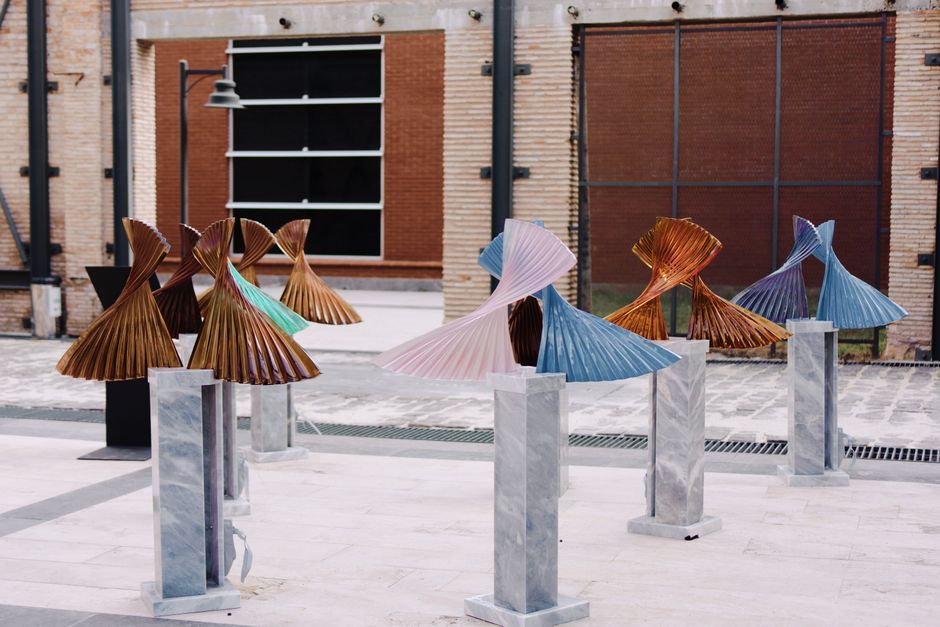
Stock photo for illustration only, not from the actual event
During fabrication, hydraulic fluid pressure is introduced into welded sheet metal assemblies, forcing the metal skin to inflate, buckle, and expand. As the material yields under extreme liquid tension, reciprocal structural profiles of concave indentations and convex bulges emerge naturally across opposite wall planes.
Hydromechanical forming is an advanced manufacturing process typically utilized in heavy industries like automotive engineering to create seamless, complex tubular parts. Translating this industrial method into sculptural design allows creators to achieve self-supporting metal envelopes where the deformed skin acts simultaneously as structure, cladding, and interior space.
The resulting reflective steel volumes permanently retain the stress concentrations and deformation marks applied during expansion. Highly polished metallic finishes capture and mirror surrounding spatial environments and lighting conditions, translating the geometry of inflated membranes into rigid, non-elastic metals.
- Simultaneous concave and convex profiles form across opposite wall planes
- Welded perimeter seams secure sheet metal edges under intense internal tension
- Polished metallic finishes highlight transitions between compressed and stretched zones
Source: designboom
Found something wrong in this article? Report an issue with this article
Comments
Leave a Comment