

Light on Brick, Paint on Cream: Coding Patterns
Exploring a web project that generates architectural patterns and ceramics from Seville and Granada using computer algorithms and lighting models.

Stock photo for illustration only, not from the actual event
- Web project generating historical architectural patterns and tiles using code
- Simulating light and shadow on Mudéjar towers like Giralda in Spain
- Tracing Fajalauza pottery motifs like pomegranates and birds via image processing
- Preparing future presets for Rejería wrought ironwork on whitewashed walls
Then the light has moved over to someone else's garden, and the flowers stand in blue, keeping their colors to themselves. This article explores a series of web pages where a computer generates algorithmic patterns: tin-glazed tiles painted by rule, cut tiles, poured cement, heraldry, knotwork, and pieces that break other pieces. These creations travel across Europe, borrowing from the art and history of each location to capture how patterns repeat throughout the artistic world.
The two latest additions are from Andalusia, specifically Seville and Granada, sitting at opposite ends of what a web page can achieve with patterns. The Sebka preset relies entirely on light and shadow without painted fills, whereas Fajalauza features rich paint without computed lighting.
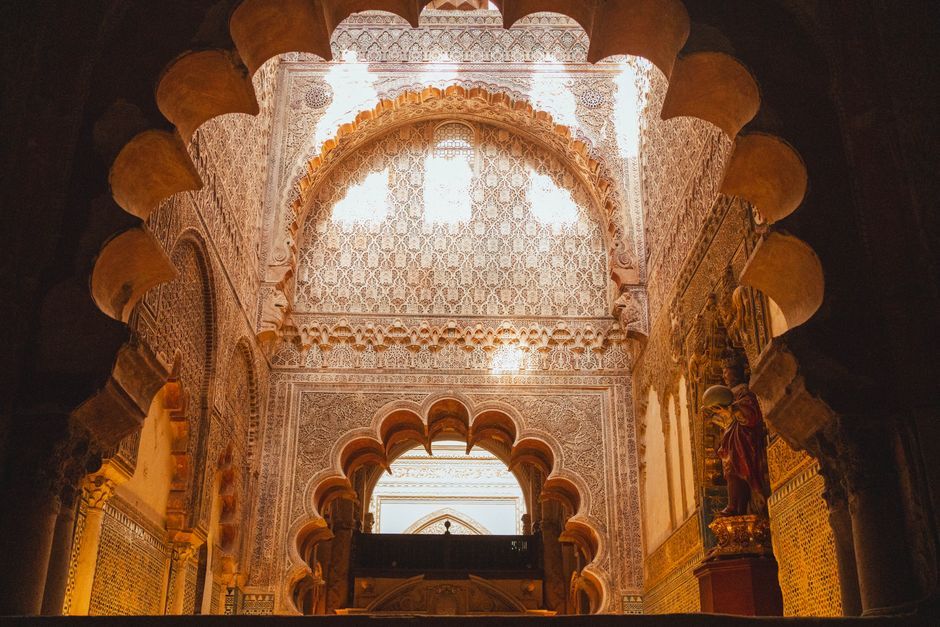
Stock photo for illustration only, not from the actual event
The network pattern on the upper storeys of the Giralda is called sebka, appearing on Mudéjar towers in Teruel and Calatayud, the Hassan tower in Rabat, and the Kutubiyya in Marrakech. Lobed arches spring from columns, crossing the wall to form a lattice of rhombi with scalloped edges.
This is the simplest rule written for these pages. It establishes a lozenge grid, shrinks each shape by the band's width, scallops the sides inward based on the requested number of lobes, and cuts them out of a brick facade. The resulting lattice is the remaining brick between the openings, ending in marble colonnettes just like the real structures.
Simulating historical patterns through computational algorithms bridges ancient craftsmanship with modern digital art. By calculating sun angles, shadow depths, and light color temperatures throughout the day, the project mirrors how medieval architects designed facades to interact dynamically with natural sunlight, offering a deeper appreciation of historical structures.
Fajalauza represents the pottery of Granada's Albaicín, featuring a cream tin glaze decorated thickly with copper green and cobalt blue. It repeatedly portrays motifs such as the city's pomegranate, a plump bird with a raised tail, and trailing branches.
Source: Dev.to
Found something wrong in this article? Report an issue with this article
Comments
Leave a Comment