

Julia Lohmann's Kelp Sculptures at the Design Museum
German designer Julia Lohmann presents five towering kelp sculptures at the More than Human exhibition in London to question industrial material demands.

Stock photo for illustration only, not from the actual event
- German designer Julia Lohmann exhibits five towering kelp sculptures at London's Design Museum.
- The Kelp Council installation imagines a gathering of marine organisms discussing environmental conditions.
- The artworks raise critical questions about how rising industrial demand for seaweed impacts ecosystems.
- Her research builds upon a long-standing exploration of material origins that began back in 2004.
In contemporary design discourse, moving beyond a human-centered approach has become a crucial agenda for creators aiming to rethink our relationship with the planet. German-born designer Julia Lohmann has continuously pushed these boundaries by investigating how living organisms are transformed into design materials, offering a provocative look at the biological systems underlying our material culture.
At London's Design Museum, Lohmann arranged five towering kelp sculptures in a circle for the 2025 exhibition More than Human. Their translucent skins stretch across ribbed frameworks, resembling unfamiliar creatures brought up from the ocean floor. Titled Kelp Council, the installation imagines a gathering of marine organisms discussing the condition of their environment, with visitors invited to join the conversation and reflect on ecological responsibilities.
Lohmann's work highlights the complex paradox of using biological alternatives in modern manufacturing. While seaweed offers a promising substitute for synthetic materials and plastics, expanding industrial harvesting can introduce unforeseen ecological pressures on marine habitats. Her speculative designs serve as a vital reminder that material innovation must be balanced with environmental stewardship.
Lohmann's fascination with the origins of everyday materials dates back long before her seaweed experiments. In 2004, she created Waltraud Cow-Bench, a leather-covered piece of furniture shaped to resemble a reclining cow. By returning the familiar material to the bodily form of the animal it originated from, she drew attention to an intimate connection that typically vanishes during mass production.
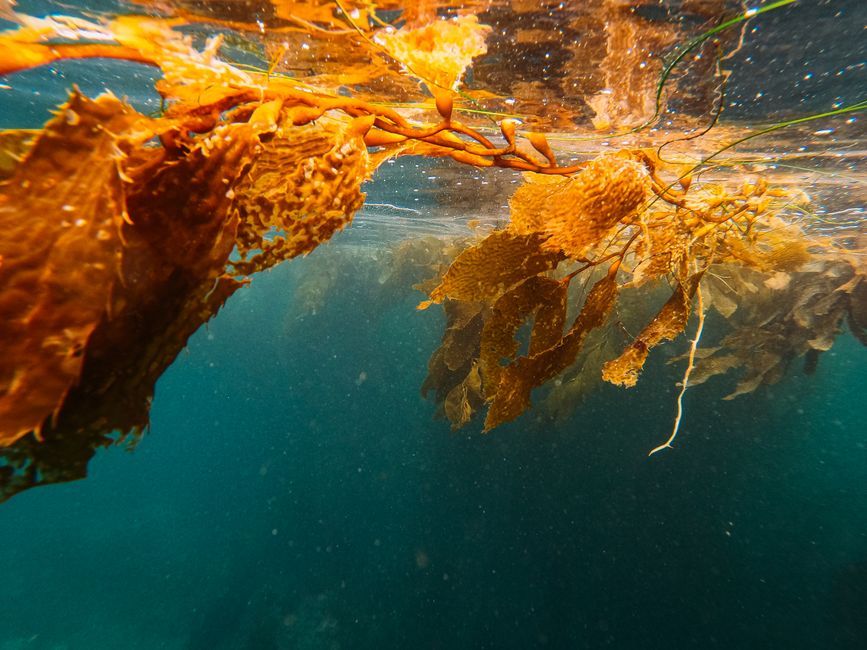
Stock photo for illustration only, not from the actual event
This line of inquiry eventually led her toward marine algae. During a 2013 residency at London's Victoria and Albert Museum, she founded the Department of Seaweed, a collaborative research initiative exploring the properties of kelp. Working alongside scientists and specialists, she developed techniques that allowed the material's natural drying and contracting properties to dictate sculptural forms, such as in Kombu Ahtola (2020) where kelp is stretched across rattan frameworks.
"The future of sustainable design depends as much on how we obtain materials as on what we make from them."
Julia Lohmann
Her architectural-scale pavilion Hidaka Ohmu, also presented in 2020, measures roughly six meters across and is wrapped in translucent seaweed panels that filter soft light into its curved interior. Through these large-scale experiments, Lohmann emphasizes that sustainable design requires careful consideration of the marine ecosystems that sustain these resources, urging creators to look far beyond conventional human-centric utility.
Source: designboom
Found something wrong in this article? Report an issue with this article
Comments
Leave a Comment