

Review: Elektron Model:Samples and Model:Cycles grooveboxes
A deep dive into affordable electronic music instruments from Elektron that reviewer Terrence O'Brien finds surprisingly powerful.

Stock photo for illustration only, not from the actual event
- Elektron Model:Samples and Model:Cycles are budget grooveboxes that are frequently overlooked.
- Model:Cycles utilizes FM synthesis while Model:Samples plays samples loaded via USB.
- Both units feature six audio tracks and tactile knobs for hands-on control.
- Equipped with Elektron's legendary step sequencer for enhanced musical flexibility.
When asked what to buy for getting into electronic music production, Terrence O'Brien frequently recommends the budget-minded Model:Samples and Model:Cycles grooveboxes from Elektron. While they may not generate the same headlines as gear from Teenage Engineering or Telepathic Instruments Orchid, and are often ignored compared to the company's higher-end niche offerings like the Digitakt, Octatrack, or Tonverk, O'Brien still finds himself returning to the Model series even as his collection expands to include far more expensive instruments.
Newcomers searching for their first groovebox often gravitate toward familiar brand names such as Korg or Roland, or follow Reddit recommendations pointing to the Novation Circuit Tracks, which the author personally finds confusing and mediocre-sounding. This trend is partly fueled by Elektron's reputation for having an obtuse workflow. Established producers unintimidated by complex workflows tend to jump straight into more powerful machines like the Digitone or Syntakt, leaving the Models lineup stranded in an awkward no man's land.
The intermediate positioning of the Model series highlights a common industry dilemma in balancing entry-level accessibility with professional synthesis depth, showing how manufacturers attempt to scale down flagship features for broader audiences.
The primary difference between the two devices is that the Model:Cycles runs on FM synthesis, whereas the Model:Samples plays pre-loaded audio files. Note that it is not technically a sampler because it cannot record audio directly and requires samples to be transferred over a USB connection.
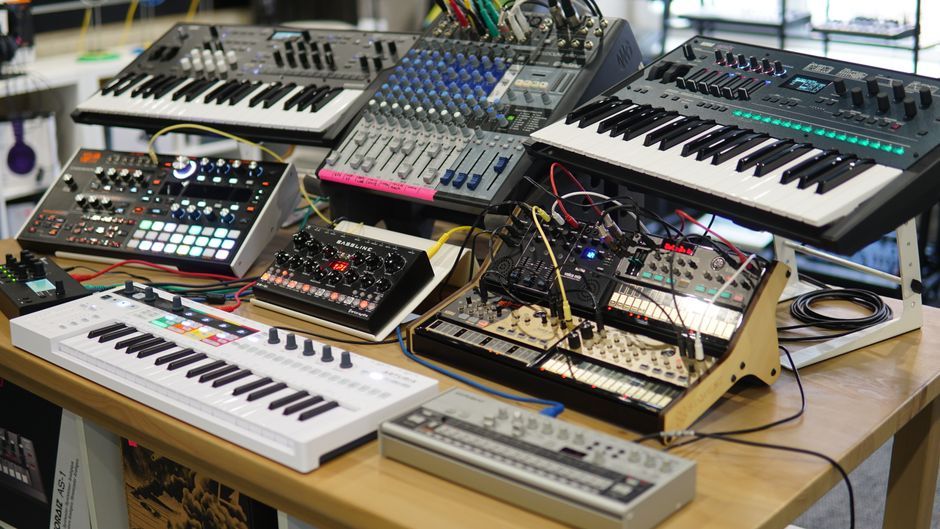
Stock photo for illustration only, not from the actual event
The Model:Cycles is built around a streamlined sound engine derived from the Digitone, offering a modern take on FM synthesis capable of producing icy pads reminiscent of the DX7 alongside modern glassy keys and aggressive EDM basslines.
Despite their differences, the two instruments share a remarkably similar foundation as six-track grooveboxes equipped with six velocity-sensitive pads, abundant physical control knobs, and nearly identical physical designs. Most importantly, they incorporate Elektron's legendary step sequencer without the intimidating complexity found in the company's costlier hardware.
The sequencer operates on concepts the company refers to as "trigs" and "locks." Trigs function as simple event triggers for notes, while locks apply step-specific parameter settings, transforming seemingly basic instruments into highly capable machines.
Working with only six tracks requires careful arrangement. After allocating tracks for a kick, snare, and hi-hat, producers are left with three remaining tracks for bass lines, melodic elements, and extra percussion. However, sound locks permit users to switch samples or presets on a per-step basis, allowing kick and snare sounds to share a single track as long as they never trigger simultaneously.
"They’re far more powerful and fun than their bargain price suggests."
Terrence O'Brien
While the sequencer can function as a straightforward step sequencer for basic four-on-the-floor beats, it scales smoothly alongside the user's growing expertise. Advanced features like trig conditions enable users to establish playback rules, such as triggering steps only every third loop iteration or when a fill button is pressed, unlocking massive compositional variety.
Source: The Verge
Found something wrong in this article? Report an issue with this article
Comments
Leave a Comment