

Ta-Chien Sun on AI Transforming Visual Effects
Ta-Chien Sun of Digital Vizen discusses AI agents and digital humans at Techsauce Global Summit 2026.
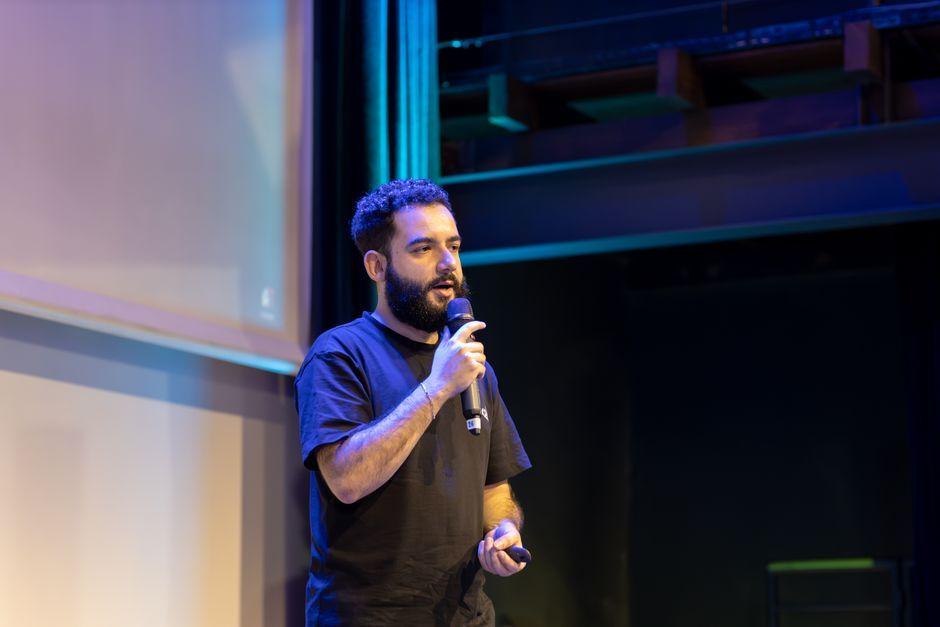
Stock photo for illustration only, not from the actual event
- Ta-Chien Sun used AI agents to create a commercial in 10 minutes.
- Digital Domain spun off its AI team into a new company named Digital Vizen.
- Organizational transformation requires managing people rather than just software.
- Digital humans bring legends Teresa Teng and Anita Mui back to the stage.
A shoe commercial was projected onto the screen in the middle of the Techsauce Global Summit 2026 stage, featuring fluid motion, consistent facial expressions, and details indistinguishable from live-action footage. The speaker announced that the entire piece was generated from a single photo and a short prompt in under 10 minutes. The person who played the video was Ta-Chien Sun, Ph.D., CEO of Digital Vizen and Managing Director of Digital Domain, the visual effects studio behind Titanic and Thanos in the Avengers universe, speaking at the session titled AI in Entertainment: Where the Blockbusters Are Really Being Made, moderated by film critic and JUSTดูIT founder Thagrit Sombunnanont.
The core message emphasized by Ta-Chien was not about tool speed, but a concluding statement: technology should never become the story itself, but should help us tell stories. Every topic discussed afterward built upon this conclusion. Before entering the film industry, Ta-Chien spent 14 years as a member of Taiwan's Legislative Yuan, explaining simply that politics in Taiwan was boring and he transitioned to entertainment when the opportunity arose. When asked about his favorite projects, he mentioned several, including Avengers: Doomsday and the new Spider-Man films.
Stock photo for illustration only, not from the actual event
While many view politics and technology as entirely separate worlds, Ta-Chien noted significant similarities between the two fields. A key lesson from 14 years in parliament is that transformation is decided not by who has the best idea, but by people. That lesson was applied when Ta-Chien drove the AI transition at Digital Domain, a three-year process far more difficult than anticipated. The obstacle was not technology, but an organization filled with Oscar-winning artists who believed they outperformed AI models. Persuading them required an approach entirely different from installing software. Furthermore, the organization included producers, executives, and clients, each viewing AI differently. Ta-Chien adopted a legislative strategy: understanding differing interests, communicating with dissenters, building consensus, and translating ideas into actionable reality.
The culmination of three years of persuasion was the decision to spin off Digital Domain's AI and virtual human teams into a new company named Digital Vizen, aiming to build upon Digital Domain's 30-year legacy while introducing specialized AI agents for content production. Distinguishing between models and agents, Ta-Chien explained that an AI model awaits prompts to generate outputs piece by piece, whereas an AI agent receives a high-level goal and autonomously executes multi-step workflows. The next horizon is physical AI, or world models. Using the shoe commercial example, the client provided a single photo while AI agents handled the rest, highlighting character consistency and facial expressions that rival feature film standards, unlike low-quality AI slop.
"Technology should never become the story itself, but should help us tell stories."
Ta-Chien Sun
Such speed naturally prompted a question from the moderator regarding how AI-generated work can evoke genuine emotion given beliefs that AI lacks a soul. Ta-Chien responded by screening behind-the-scenes footage of Thanos. The lesson of Thanos is that technology alone does not create great digital characters; human performance does. When audiences sit in theaters, they care little about polygon counts or rendering layers; they care about believing in the character on screen. Behind the digital character lies actual human performance—facial expressions, emotions, and timing. Technically, Digital Domain developed a system called Masquerade, mapping head-mounted camera footage of actors into high-resolution, frame-by-frame facial scans to drive Thanos in Avengers: Infinity War and Avengers: Endgame, according to Digital Domain and fxguide data, entirely in service of human performance.
The transformation in entertainment and visual effects illustrates that AI serves not to replace human creativity, but as a powerful tool to streamline repetitive tasks and accelerate initial production phases. The synergy between agentic technology and artistic craftsmanship represents the primary trajectory for blockbuster filmmaking.
If human performance breathes life into digital characters, the next frontier involves creating genuine emotional connections through AI, showcased by bringing back legendary superstars across Asia. The first is Teresa Teng, the legendary Taiwanese and Chinese singer who passed away in 1995, and the second is Anita Mui, the Hong Kong superstar who passed away in 2003. Both were recreated as digital humans to pass their artistic legacy to new generations. Digital Domain's website notes that Teresa Teng's virtual human project began in 2013, while a 2016 company announcement confirmed an agreement with Anita Mui's estate for intellectual property rights to produce her digital human as the second project. Ta-Chien emphasized that the scope extends beyond screens to live stage performances before audiences of 20,000 in immersive concert settings.
Source: Techsauce
Found something wrong in this article? Report an issue with this article
Comments
Leave a Comment