

Coral: White Stainless-Steel Swing Installation in Yantai
XBTW Office transforms the Yantai coastline in China into an underwater world with twelve oversized white stainless-steel cylinders.
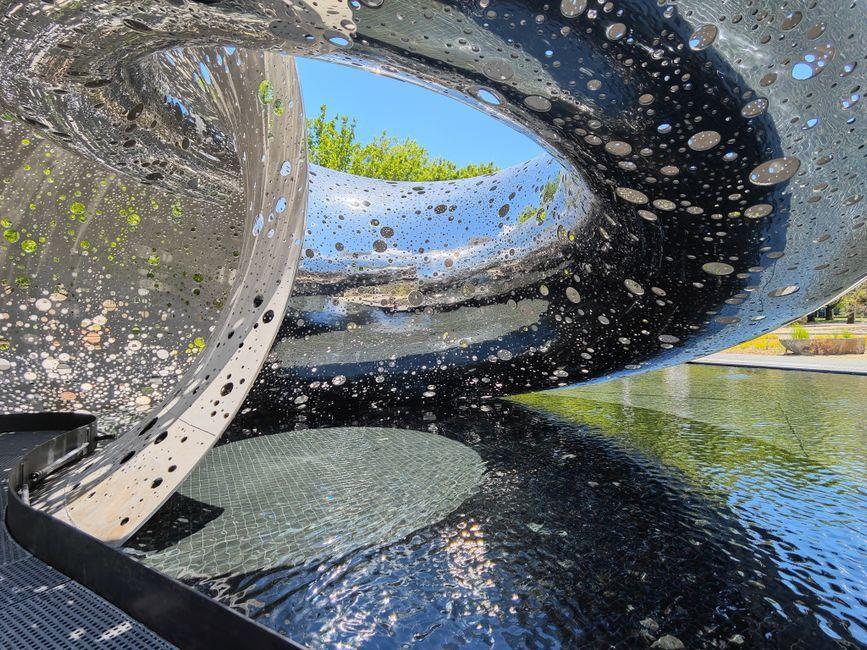
Stock photo for illustration only, not from the actual event
- Coral is an interactive swing installation designed by XBTW Office at West Park in Longfor Puti peninsula, Yantai.
- The structure features twelve oversized white stainless-steel cylinders arranged in two groups with a horizontal roof plane.
- Each cylinder contains between 2,000 and 4,000 perforations ranging from 4 to 25 millimeters in diameter.
- West-facing swings are suspended beneath the structure to let visitors enjoy the sea breeze and sunset.
Creative practice XBTW Office has unveiled a new public art installation named Coral, situated at the northwest corner of West Park on the Longfor Puti peninsula in Yantai, China. Facing tidal flats and the open sea, the location is shaped by the daily rhythms of tides, sea breezes, and sunsets, which combine to create a distinctive coastal landscape. The project is designed to let visitors wander through shifting frames of sea and sky, or swing toward the horizon while experiencing the natural elements through physical movement.
The form of the installation draws inspiration from the repetition and aggregation patterns found in coral colonies. The designers utilized twelve white stainless-steel cylinders as the primary units, organized into two groups positioned above and below. A thin horizontal roof plane slices through the composition, suspending two west-facing swings underneath it. Positioned at varying heights and orientations, the cylinders overlap and shift against one another to form an inhabitable space where people can enter, navigate, and pause.
Viewed from afar, the white forms emerge along the open shoreline like an unfamiliar marine organism. As visitors approach, the gaps between the cylinders gradually reveal fragments of tidal flats, water, and sky, turning the continuous scenery into a series of dynamic frames. Entering the interior shifts the relationship between the human body and scale, as the oversized cylinders surround visitors and temporarily make the familiar coastline feel like an underwater realm.
Stock photo for illustration only, not from the actual event
The integration of large-scale geometric structures into coastal public spaces represents a growing trend in contemporary interactive art. Beyond offering visual appeal, such installations encourage visitors to engage directly with their natural surroundings, while the reflective white stainless-steel material allows the sculptures to dynamically interact with changing daylight.
The perforated patterns on the cylinders are inspired by the varying density of deep-sea fish schools. Each cylinder features approximately 2,000 to 4,000 openings of different sizes, ranging from 4 to 25 millimeters in diameter. The gradient texture created by these openings evokes the gathering and dispersing movement of fish. Additionally, a select number of larger perforations take the shapes of marine creatures such as starfish, octopuses, and seashells.
After sunset, light filters through the perforations, transforming the quiet white structures into a glowing state that resembles breathing marine life. The project was realized with engineering by Shanghai Leqiu Playground Equipment Co., Ltd. and general contracting by Liaoning Lumei Yanyuan Construction Engineering Co., Ltd., with photography captured by Zhu Yumeng and DONG Image.
Source: designboom
Found something wrong in this article? Report an issue with this article
Comments
Leave a Comment