

Nick Cave’s Soundsuits Bring the Stage into Crowds
Explore Nick Cave’s wearable Soundsuits that conceal identity and generate sound through movement, turning public spaces into dynamic stages.
Stock photo for illustration only, not from the actual event
- Soundsuits are wearable sculptures that envelop the human figure and generate percussion.
- The suits conceal gender, race, and class to encourage judgment-free viewing.
- Performances have taken place in public spaces like Grand Central Terminal and Park Avenue Armory.
- Materials range from discarded objects, feathers, beads, and buttons to synthetic fibers.
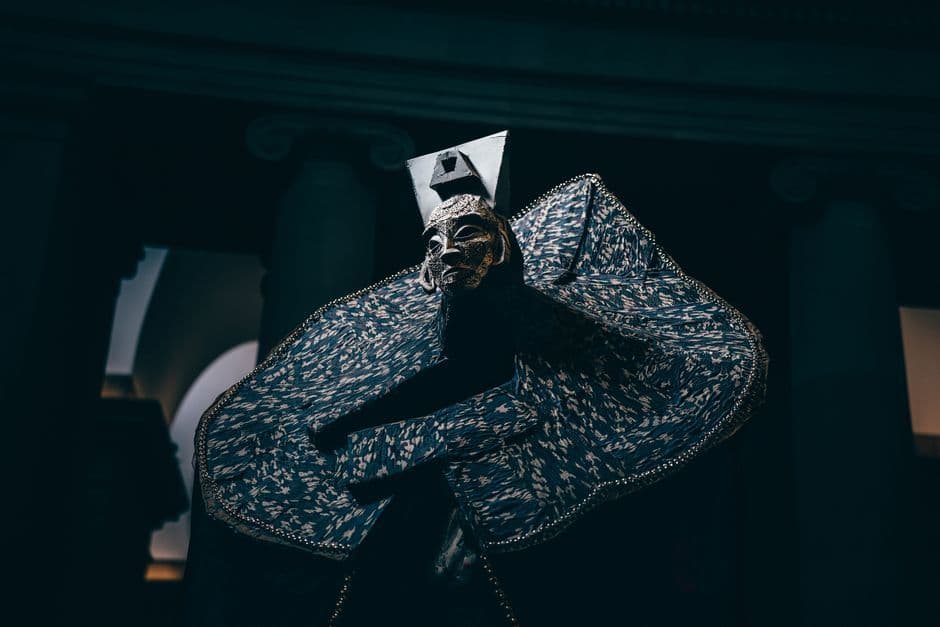
Imagine a sculpture that does not sit on a plinth, but moves through a train station, a street, or a crowded hall. Its surface rattles with every step, its scale alters the silhouette of the person inside, and its elaborate construction makes the wearer almost impossible to identify. This is the basic proposition of Nick Cave’s Soundsuits: the garment becomes an environment, and the body becomes its architecture.
Soundsuits are wearable sculptures that completely envelop the human figure. They can incorporate fabric, wire, raffia, feathers, beads, buttons, sequins, plastic toys, ceramic objects, synthetic fibers, rugs, quilts, and other found materials. Their surfaces are often densely assembled, turning ordinary objects into highly elaborate bodies.
The materials have changed considerably since the original twig suit, but the principle of accumulation remains. Cave gathers discarded and everyday objects and reorganizes them into forms that are difficult to classify. A suit made from hundreds of small plastic figures, for example, can become something closer to a moving landscape than a conventional garment.
Stock photo for illustration only, not from the actual event
Through the Soundsuit, Cave builds the stage onto the performer. The suit expands the body beyond its ordinary proportions. Strands of raffia extend into the surrounding air; beads and other elements move independently; rigid frames establish new silhouettes. When the wearer walks or dances, the sculpture alters the space around them, establishing a boundary between them and the outside world while simultaneously projecting outward into it.
Without a recognizable face or body, the viewer has fewer visual cues through which to categorize the person inside. Cave has explained that the suits ‘hide gender, race, class’ and force audiences to look at the work without judgment. The anonymity is not neutral, however. It originates in a specific experience of racial vulnerability. Cave’s work does not erase that history so much as transform it into a question: what happens when the visual information through which people are routinely judged disappears?
‘hide gender, race, class’
Nick Cave
Nick Cave’s Soundsuits bridge contemporary sculpture, performance art, and social engagement. Drawing inspiration from African ceremonial dress and African-American craft traditions, these wearable artworks challenge perceptions of identity while transforming ordinary urban architecture into shared communal stages.
For Heard NY in 2013, Cave worked with 30 dancers in horse-like Soundsuits who moved through Grand Central Terminal accompanied by live music. The performance interrupted the everyday routes of commuters. A building designed for circulation became, temporarily, a theater.
Source: designboom
Found something wrong in this article? Report an issue with this article
Comments
Leave a Comment