

Unlocking the Secrets of Somdej Wat Rakkhang Chedi Mould and Royal Artisan Techniques
An in-depth look at the extra-thick Somdej Wat Rakkhang amulets in Chedi and Ket Bua Tum molds, exploring their design roots from the Emerald Buddha and Western perspective techniques.

Stock photo for illustration only, not from the actual event
- Somdej Wat Rakkhang Chedi and Ket Bua Tum molds feature an unusual thickness up to double the standard.
- Royal artisans used the Emerald Buddha in rainy season attire as the primary design template.
- The Chedi mold was carved using a perspective angle shifted about 45 degrees to the left of the front view.
- The Yai mold utilized the Phra Prathan Yim Rab Fa as a template with full Western perspective techniques.
According to research records by an anonymous writer in Precious Magazine, the Somdej Wat Rakkhang amulets in Chedi and Ket Bua Tum molds are uniquely characterized by an exceptional thickness, measuring up to twice that of standard pieces. This occurred because royal artisans meticulously carved these two molds following their initial trial with the less refined Than Saem mold. With plenty of amuletic material remaining, the artisans pressed the mixture into the molds to maximum capacity, with the Ket Bua Tum mold created slightly earlier and containing more sacred material than the Chedi mold.
Insights previously published by "The Science of Somdej" suggest that the artisans likely based the design of the Chedi mold on the Emerald Buddha adorned in rainy season attire. Similarly, the Ket Bua Tum mold shares this sacred template, evidenced by its large head, decorative ear flaps resembling royal crowns, and prominent heavy chins mirroring the Emerald Buddha. Furthermore, the Ket Bua Tum mold displays a robust physique closely matching the Emerald Buddha, while certain sub-molds of the Chedi mold exhibit deep torsos characteristic of high-relief sculpture.
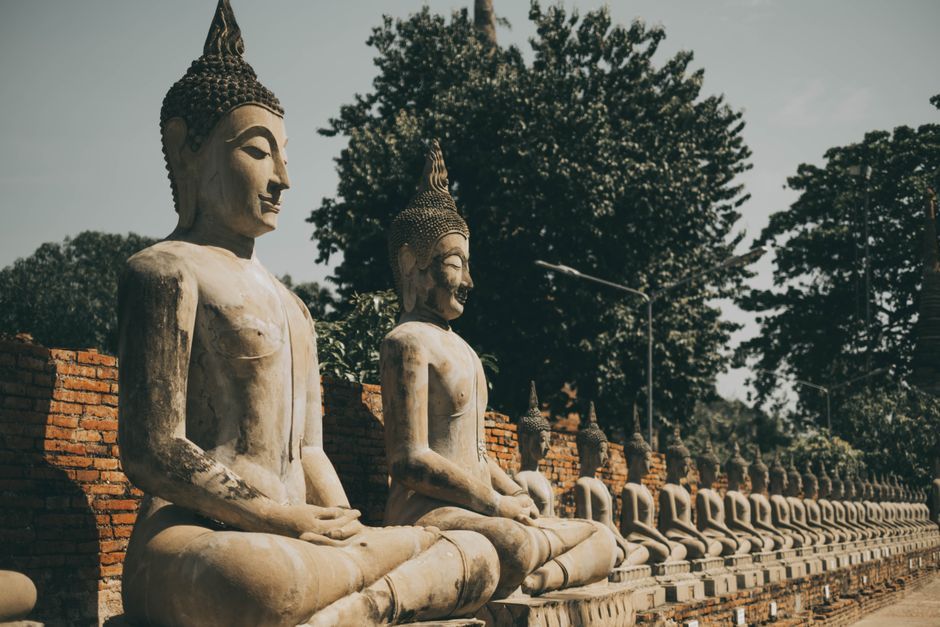
Stock photo for illustration only, not from the actual event
The sequence of mold creation began with Ket Bua Tum and Chedi, followed subsequently by the Yai mold. Master experts note that the Yai mold used the principal Buddha image "Phra Prathan Yim Rab Fa" inside the ubosot of Wat Rakkhang as its model, incorporating simplified features alongside advanced Western perspective techniques to achieve the highest level of craftsmanship. Meanwhile, the Prok Pho mold was created for a special occasion later on by modifying existing matrices, as documented in Triampavai's textbooks.
The application of Western perspective principles in carving 19th-century Thai amulets highlights a fascinating cultural and artistic crossover during the reign of Somdet Phra Phutthachan (To Phromrangsi). Royal craftsmen began experimenting with spatial depth, light, and viewing angles rather than adhering strictly to traditional flat iconography, creating distinct markers that modern collectors use for authentication.
Regarding symmetry, almost all Somdej Wat Rakkhang molds are symmetrical except for the Yai mold, which appears to tilt toward the Buddha's right due to the artisan viewing the image slightly from the left front angle. Although the Chedi mold appears symmetrical overall, it features distinct characteristic traits and structural flaws that raise questions about the craftsman's perspective.
To explain these hidden design secrets, "The Science of Somdej" proposes that while the earlier Ket Bua Tum mold was carved from a direct frontal view ensuring symmetry, the Chedi mold was carved from an angle shifted approximately 45 degrees to the left. This specific viewing angle created the signature upturned boat curve of the top pedestal, the inward-tapering arms, and the slight elevation of the left armpit. Despite utilizing this angled perspective, the carving did not follow strict rules as rigidly as the Yai mold, which utilized a 15 to 30-degree perspective, thus preserving an overall balanced and symmetrical appearance.
Source: Thairath Lifestyle
Found something wrong in this article? Report an issue with this article
Comments
Leave a Comment