

PRISMBODY at MET: Translating Synesthesia into Light
At The Metropolitan Museum of Art on September 20, 2026, Audrey Wright and Geoff Robertson debuted a wearable synesthesia-to-light art project.

Stock photo for illustration only, not from the actual event
- Audrey Wright and Geoff Robertson presented Luminous Being at The Metropolitan Museum of Art.
- They are developing PRISMBODY alongside composer Stephanie Ann Boyd.
- The original wearable garment features 46 display panels and over 3,000 LEDs.
- Garment 2.0 introduces RGB LEDs and transparent wrap-around display panels.
At The Metropolitan Museum of Art, violinist Audrey Wright wears an array of electronics across her body while her husband and creative partner Geoff Robertson operates a tablet nearby. As Wright plays her instrument, Robertson navigates through visual software that projects light across the wearable display. This setup originates from Luminous Being, a project the duo launched in performances back in 2024.
Building upon their previous work, they are currently collaborating with composer Stephanie Ann Boyd to develop PRISMBODY. This new piece uses Boyd's personal synesthetic experience of music as its primary foundation, exploring methods to render her internal perceptions visible to a live audience.
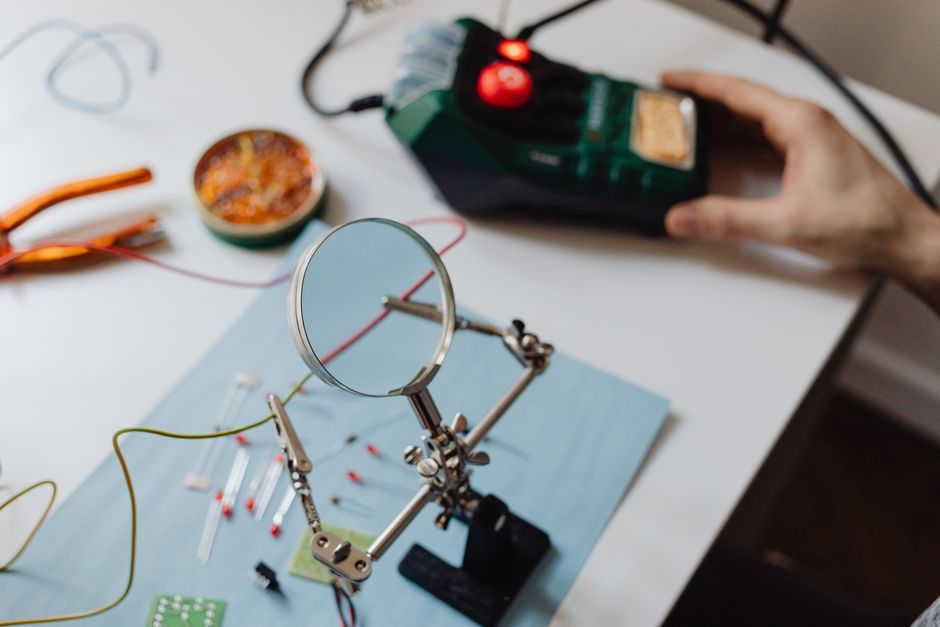
Stock photo for illustration only, not from the actual event
On the hardware side, Robertson constructed the initial garment entirely by himself, teaching himself electrical engineering and programming along the way. The wearable framework incorporates 46 display panels distributed across Wright's chest and back, embedded with more than 3,000 individual LEDs.
The garment operates on 47 onboard batteries and hosts a dedicated Wi-Fi network, allowing Robertson to interface via tablet and trigger distinct visual sequences during a live set. An integrated microphone also captures Wright's performance, routing audio data directly into specific visual effects. The entire technical system runs at roughly 30 frames per second.
“a codifying of my synesthesia.”
Stephanie Ann Boyd
For this upcoming composition, Boyd has begun structuring these perceptual color associations directly into the musical score. She describes PRISMBODY as a formal codification of her synesthesia, where distinct musical passages transition through specific color fields tied to her internal perception while Wright layers violin tracks using loop pedals.
This artistic progression demands broader capabilities from the wearable hardware. The original garment relies on five fixed LED colors per display panel, leaving minimal room for the subtle hues that Boyd associates with individual musical notes. To solve this limitation, Garment 2.0 integrates RGB LEDs capable of generating a substantially expanded color spectrum.
Stock photo for illustration only, not from the actual event
Synesthesia is a neurological condition where stimulation of one sensory pathway leads to automatic experiences in a second pathway, such as perceiving specific colors when hearing musical sounds. Translating this private sensory phenomenon into physical garments and real-time computational displays represents an ambitious intersection of live musical performance, wearable electronics, and cognitive art.
The second-generation garment also features an expanded physical footprint. Robertson is currently engineering transparent display panels designed to wrap entirely around Wright, superseding the flat front-and-back configuration of the first model. Furthermore, external spotlights are evolving into sculptural architectural extensions of the wearable tech, casting illumination outward into the venue. The presentation took place on September 20, 2026, at The Metropolitan Museum of Art as part of the Creative Convening: Musical Bodies event.
Source: designboom
Found something wrong in this article? Report an issue with this article
Comments
Leave a Comment