

10 Fashion Shows That Rewrote the Traditional Catwalk
Explore 10 legendary fashion shows across four decades by visionary designers like Thierry Mugler and Alexander McQueen that broke runway rules.
Stock photo for illustration only, not from the actual event
- Revisiting 10 legendary fashion shows that revolutionized traditional runway formats
- Thierry Mugler's 1984 show utilized a wing-shaped stage for over 6,000 attendees
- Maison Martin Margiela's 1990 show took place inside a Parisian playground
- Alexander McQueen's 2001 show featured a massive two-way mirrored box
Fashion shows typically begin with a straightforward diagram. Models move along a prescribed path, its edges lined with spectators, and everyone knows where to look. In general, this basic layout has remained consistent across time. Yet some of the strongest runway sets begin by disturbing that diagram.
Across four decades, designers and scenographers have buried the catwalk beneath the floor, broken it into a grid, or removed the act of walking altogether. In these shows, set design shapes much more than just a decorative backdrop. It determines when a model appears and how long they stay visible, and can even determine whether two viewers sitting a few feet apart experience the same sequence. During this season of fashion weeks, we return to ten examples where the runway itself became part of the choreography.
For Thierry Mugler's fall 1984 show at Le Zénith in Paris, the runway unfolded through the concert venue like a pair of wings. It was one of the first examples of a runway show dreaming beyond the quiet, standard setup. More than 6,000 people filled the room, including paying members of the public, pushing the fashion show beyond the scale of the usual industry presentation.
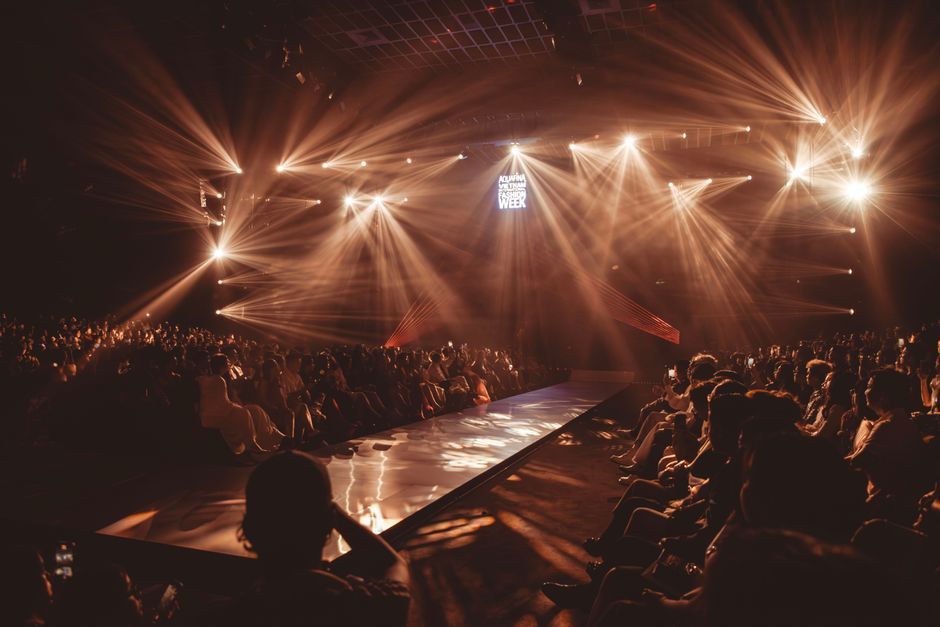
Stock photo for illustration only, not from the actual event
The plan suited Mugler's theatrical language, but its effect was spatial first. Distance became part of the show. A figure could register as a silhouette from across the arena before moving closer into view, while the runway reached outward toward spectators instead of holding them along one straight edge. The traditional catwalk had been stretched into something closer to a diagram for a crowd.
Maison Martin Margiela's spring/summer 1990 show, presented in fall 1989, moved fashion onto a playground in Paris's 20th arrondissement. Local children sat along the dirt paths, then began moving among the models as the show continued. The route never hardened into a polished runway, remaining part of the ground everyone was already occupying.
Martin Margiela's choice to stage a runway in a public playground broke away from the exclusive, closed-off nature of 1990s high fashion. By integrating local children and unpolished terrain, the designer blurred the boundary between observer and participant, laying ideological groundwork for contemporary immersive presentations.
Viktor & Rolf pushed the idea in another direction for their fall 1999 couture collection, Russian Doll. Maggie Rizer stood on a rotating platform while Viktor Horsting and Rolf Snoeren dressed her layer by layer, building the collection onto a single body without any procession of models.
Alexander McQueen's spring/summer 2001 show, Voss, begins before a model appears. Guests sit around a huge two-way mirrored box and see their own reflections staring back at them. Once the lights shift, the interior becomes visible from outside, while the models inside remain unable to see the audience.
Stock photo for illustration only, not from the actual event
For Prada men's spring/summer 2012, AMO treated seating and catwalk as a single plan. Six hundred guests sat on individual blue foam blocks spaced across a 1.5-by-1.5-meter grid, while models followed several choreographed routes through artificial grass covering the floor.
Source: designboom
Found something wrong in this article? Report an issue with this article
Comments
Leave a Comment