

Ibrahim Mahama The Harvest Season Exhibition 2026
Ghanaian artist Ibrahim Mahama presents his major exhibition The Harvest Season at Fondation Cartier in Paris from October 22, 2026, to February 28, 2027.

Stock photo for illustration only, not from the actual event
- Ibrahim Mahama presents his major exhibition The Harvest Season in Paris
- The exhibition runs from October 22, 2026, to February 28, 2027
- Features traditional Asante wooden stools and a repurposed Ghanaian glass factory
- Explores colonial history and labor through the process of artistic repair
Ghanaian contemporary artist Ibrahim Mahama has spent years collecting, dismantling, and rebuilding industrial remnants and everyday objects deemed beyond repair. His artistic practice focuses on what societies leave behind, drawing deep connections to northern Ghana where the enduring legacy of colonial exploitation continues to shape regional identities and power dynamics.
These inquiries culminate in The Harvest Season, Mahama’s major solo exhibition scheduled at Fondation Cartier in Paris from October 22, 2026, to February 28, 2027. Developed alongside nine artists and collectives from the Ghanaian art scene, the presentation integrates large-scale installations, industrial fragments, and open spaces designed for public engagement.
A central installation in the exhibition is Parliament of Ghosts, featuring a collection of traditional Asante wooden stools gathered in Ghana that show signs of damage. These cultural objects mark significant life milestones, from birth ceremonies to the coronation of community leaders. Many similar African artifacts were removed during the colonial era and placed inside Western museum displays. Mahama negotiated with owners to bring these stools to his Red Clay art center in Tamale, where schoolchildren participated in their restoration.
"We were not thinking of these objects as ethnographic objects. We’re just thinking of them as living beings."
Ibrahim Mahama
Rather than hiding the scars of damage, Mahama views them as vital components of the objects' ongoing history. Transporting these stools to Paris creates a parliamentary setup where museum visitors can gather to debate contemporary cultural and historical questions, challenging conventional museum frameworks and advocating for institutional spaces to embrace radical dialogue.
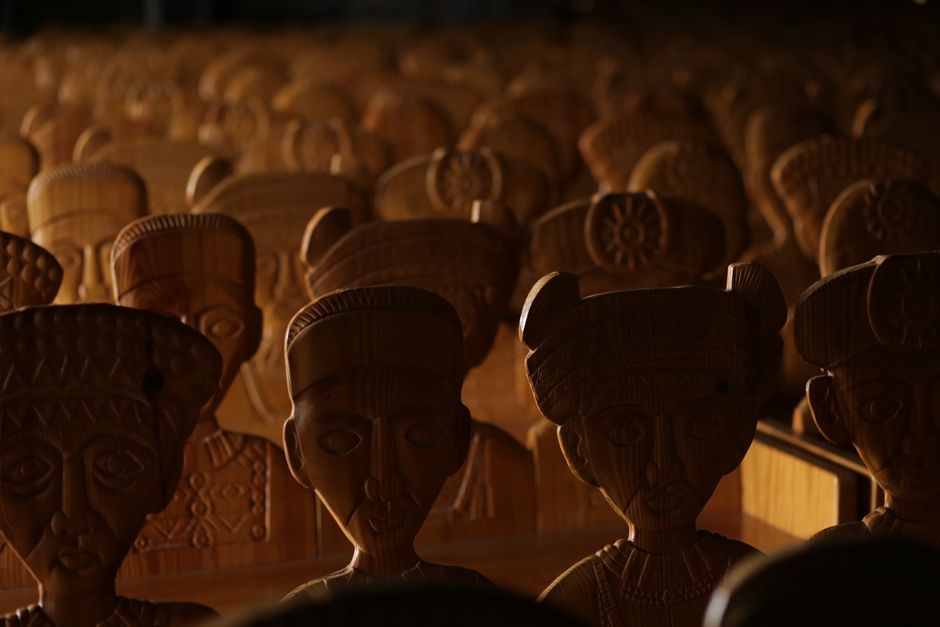
Stock photo for illustration only, not from the actual event
By repurposing historical artifacts and engaging local communities in the physical restoration process, Mahama bridges the gap between institutional archives and living cultural memory. This methodology transforms passive museum exhibits into active public forums for critical discourse on post-colonial identities.
Mahama applies a similar restoration philosophy to architecture, acquiring a former glass bottle factory built in Ghana between 1961 and 1966 that was later sold for scrap. Utilizing funds from Fondation Cartier, his team reassembled the pavilion structure in France and rescued approximately 300,000 abandoned glass bottles destined for destruction to serve as a classroom and performance space.
Through these interventions, Mahama emphasizes that art must confront historical decay, arguing that acknowledging uncomfortable pasts enables society to approach the future with renewed awareness and critical perspective.
Source: designboom
Found something wrong in this article? Report an issue with this article
Comments
Leave a Comment