

Swiss researchers develop MIR, a miniature dental robot for single-visit treatments with high precision
A team of Swiss researchers has developed the MIR miniature dental robot to grind teeth and complete crown procedures in a single visit, reducing complicated steps and minimizing margin of error.
Stock photo for illustration only, not from the actual event
- Swiss researchers develop the miniature MIR robot specifically for dental procedures
- Ultra-compact size of just 43x26x28 mm, lightweight design achieved by routing cables to an external control unit
- Tests on dental phantoms show a maximum deviation of no more than 0.2 mm and a pressure limit under 5 Newtons
Visiting the dentist for traditional crown procedures that require multiple clinic trips could become a thing of the past, as a research team from the University of Basel in Switzerland has developed a miniature dental robot capable of precisely grinding teeth according to treatment plans. This allows dentists to fit patients with permanent crowns during their very first visit.
This prototype robot, named MIR (Miniature Intraoral Robot), is designed to be exceptionally compact at just 43 by 26 by 28 millimeters—roughly the size of a wine bottle stopper—allowing it to operate comfortably inside the human oral cavity. The robot does not house internal motors; instead, it connects via cables and tubes to an external control unit, resulting in a lightweight body capable of agile movement.
The genesis of this project stems from a concept by the Center for Dental Medicine at the University of Zurich, followed by collaborative development with the University of Basel team. The workflow begins with an intraoral scan to map out target locations and the precise amount of tooth structure to remove. This scan data is then used to 3D-print a custom dental splint that serves as a base to lock the robot securely onto the patient's teeth. Consequently, no matter how the patient moves their head, the robot moves synchronously with them, preserving grinding accuracy and preventing errors.
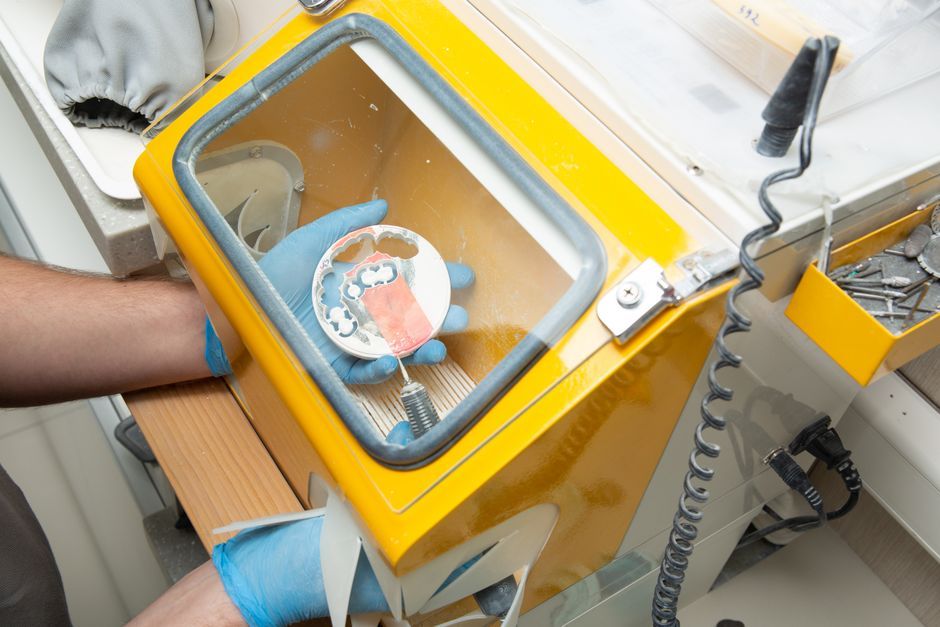
Deploying a miniature robot that attaches directly to the teeth represents a novel approach in digital dentistry. It addresses issues such as hand tremors from practitioners and patient movement during treatment, significantly reducing procedure time and patient anxiety.
Trial runs on dental phantoms revealed that the MIR robot can grind teeth with high precision, maintaining an error margin of under 0.2 millimeters and operating pressure under 5 Newtons, which is equivalent to the weight of a half-liter water bottle. Furthermore, the research team is currently testing the machine's operational noise levels to evaluate its suitability for real-world application in dental clinics.
Despite promising initial results, the MIR robot is still in the early stages of development and is not yet ready for human clinical trials. In the next phase, the research team plans to integrate additional sensors and cameras into the robot, allowing the system to identify positions and track treatment procedures in real-time. It will also be capable of resuming work immediately in the event of disruptions such as power outages. The primary challenge lies in adding these functions without increasing the robot's overall footprint.
This development project has received funding from Innosuisse, the Swiss Innovation Agency, through a multi-institutional collaboration involving the University of Basel, the Center for Dental Medicine at the University of Zurich, Camlog Biotechnologies GmbH, and the University of Bern. This reflects the growing trend of robotic technology playing an increasingly vital role in dentistry to enhance treatment precision and speed under the supervision of dental professionals.
Source: Techsauce
Found something wrong in this article? Report an issue with this article
Comments
Leave a Comment